You're on an H-1B in Austin, and the cheapest route home to Delhi for the holidays runs through Changi. Singapore looks like a perfect three-day stopover. The catch: your Indian passport still needs a Singapore visa, and your US status changes the rules in only one situation.
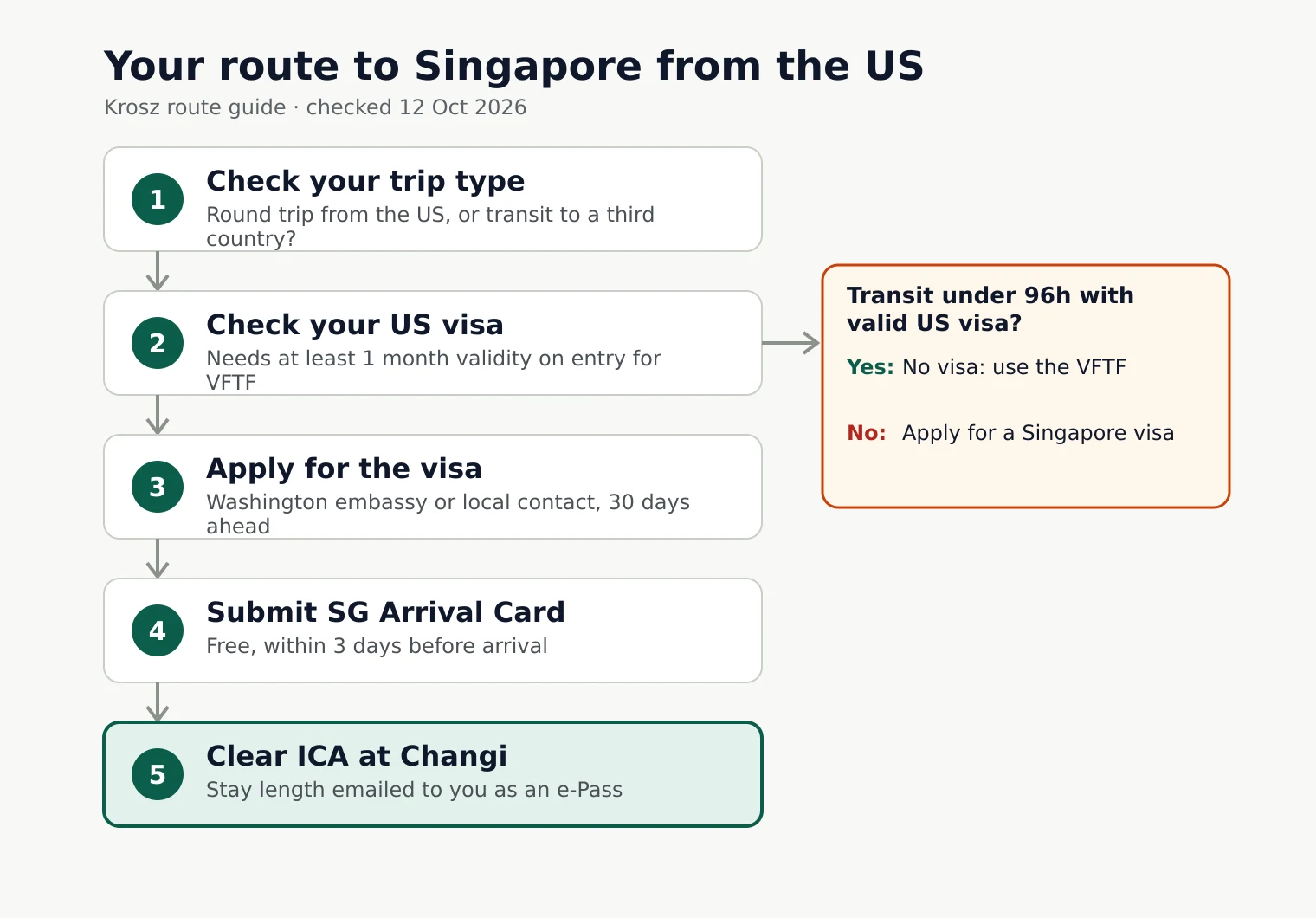
Indians living in the US still need a Singapore visa for a normal trip. The exception is a transit stop of up to 96 hours on the way to or from another country, if you hold a valid US visa with at least one month left on it.
Does living in the US change the Singapore rules?
Mostly, no. Singapore's Immigration & Checkpoints Authority (ICA) lists India among the countries whose travel documents need a visa to enter. Where you live does not change that. A round trip from the US to Singapore and back is a normal visit, so you need a visa.
Your US visa matters for one thing: the 96-hour Visa Free Transit Facility (VFTF). It is open to Indian nationals who are travelling to or from a third country via Singapore. For more on how residence and passport interact, see our guide on passport vs residency visa rules.
Singapore at a glance for US-based Indians
| Question | Answer |
|---|---|
| Visa needed for a holiday? | Yes, India is on ICA's visa-required list |
| Visa-free transit? | Up to 96 hours, with conditions (see below) |
| Where to apply from the US | Singapore Embassy, Washington D.C. (in person by appointment or by mail), or via a Singapore local contact online |
| Embassy processing fee | US$23, money order or cashier's check |
| Processing time (embassy) | 3 to 8 business days, no express service |
| When to apply | Within 30 days before arrival |
| Passport validity | At least 6 months from entry |
| Arrival form | SG Arrival Card, free, within 3 days before arrival |
Can I use the 96-hour visa-free transit?
ICA's conditions for Indian nationals are precise. You qualify only if all of these are true:
- You are in transit to or from a third country via Singapore, for example US to India with a stop in Singapore.
- You hold a confirmed onward air, ferry or cruise ticket leaving Singapore within 96 hours. You may arrive by any mode but must leave by air or sea.
- You hold a valid visa or long-term pass for the US, UK, Canada, Australia, New Zealand, Germany, Switzerland or Japan, valid for at least one month from the day you enter Singapore.
- You meet normal entry requirements. ICA officers decide at the checkpoint, and extensions are not allowed.
An H-1B, L-1 or F-1 visa stamp with a month or more left fits the rule. If your US visa stamp has expired but your status is valid, you do not meet the visa condition. ICA does not name the US green card in the list, so green card holders should confirm with ICA before relying on the VFTF.
How do I apply from the US?
From the US you have three routes:
- Through a local contact. A Singapore citizen or permanent resident over 21 with a Singpass account can submit online through ICA's SAVE e-Service.
- In person at the Singapore Embassy in Washington, D.C. By appointment only, Monday to Friday, 9 am to 1 pm. Book by email at singemb_was@mfa.sg.
- By mail to the Singapore Embassy, 3501 International Place NW, Washington, D.C. 20008. Use a tracked courier.
The embassy fee is US$23 per application, non-refundable, paid by money order or cashier's check only. Processing takes three to eight business days from receipt of a complete file, with no expedited service. ICA advises applying within 30 days before arrival, so plan for postal time too.
What documents does the embassy want?
- Form 14A, completed and signed.
- One recent colour photo, taken within the last three months, on a white background.
- Copy of your passport bio page, valid at least six months from your entry date.
- Flight and hotel reservations or a detailed itinerary.
- Proof you can return to the US: a copy of your green card, US visa, or documents such as your I-20.
- A daytime phone number and email on a separate sheet.
A Letter of Introduction (Form V39A) may be asked for case by case. If approved, you get an e-Visa. Your length of stay is set by ICA on arrival and emailed to you as an e-Pass, not tied to the visa's validity.
Mistakes that get applications refused
- Sending cash or a personal cheque instead of a money order or cashier's check.
- Applying too early or too late. Stay inside the 30-day window and leave room for mail.
- Leaving out proof of US status. The embassy asks for it specifically.
- A passport with less than six months left from your entry date.
- Assuming the VFTF covers a return trip from the US. It only covers transit to or from a third country.
More common pitfalls are in our list of visa rejection reasons for Indian applicants.
What about the SG Arrival Card and getting back into the US?
Every visitor, including visa holders, must submit the SG Arrival Card within three days before arrival, counting the arrival day. It is free on ICA's website or the MyICA app. Ignore paid sites. It is not a visa.
Before you fly back, check your US paperwork. You need a valid US visa stamp to re-enter unless you hold a green card. F-1 students need an I-20 endorsed for travel by their DSO. Green card holders absent for under a year can re-enter on the card itself.
Get your Singapore visa with Krosz in 5 steps
- Pick Singapore and your trip type. Open Singapore visa on Krosz and choose tourist, business or family visit. You see the full price before you start: ₹1,999 Krosz service fee + GST, plus the government fee.
- Sign in with a one-time code. No password to remember: enter your email and type the OTP we send.
- Upload your passport and photo. Krosz reads your passport page and pre-fills your details, so you only check them.
- Add your trip details and pay securely. Dates, entry point and where you're staying, then pay by UPI, card or net banking.
- A Krosz visa expert checks everything, then submits. A trained expert reviews every document one-to-one before it reaches the government, and you track the status until your visa arrives by email.
Start your Singapore visa with Krosz →
Rules and fees last checked on 12 October 2026. Visa rules change often: always confirm on the official government website or with your airline before you fly.