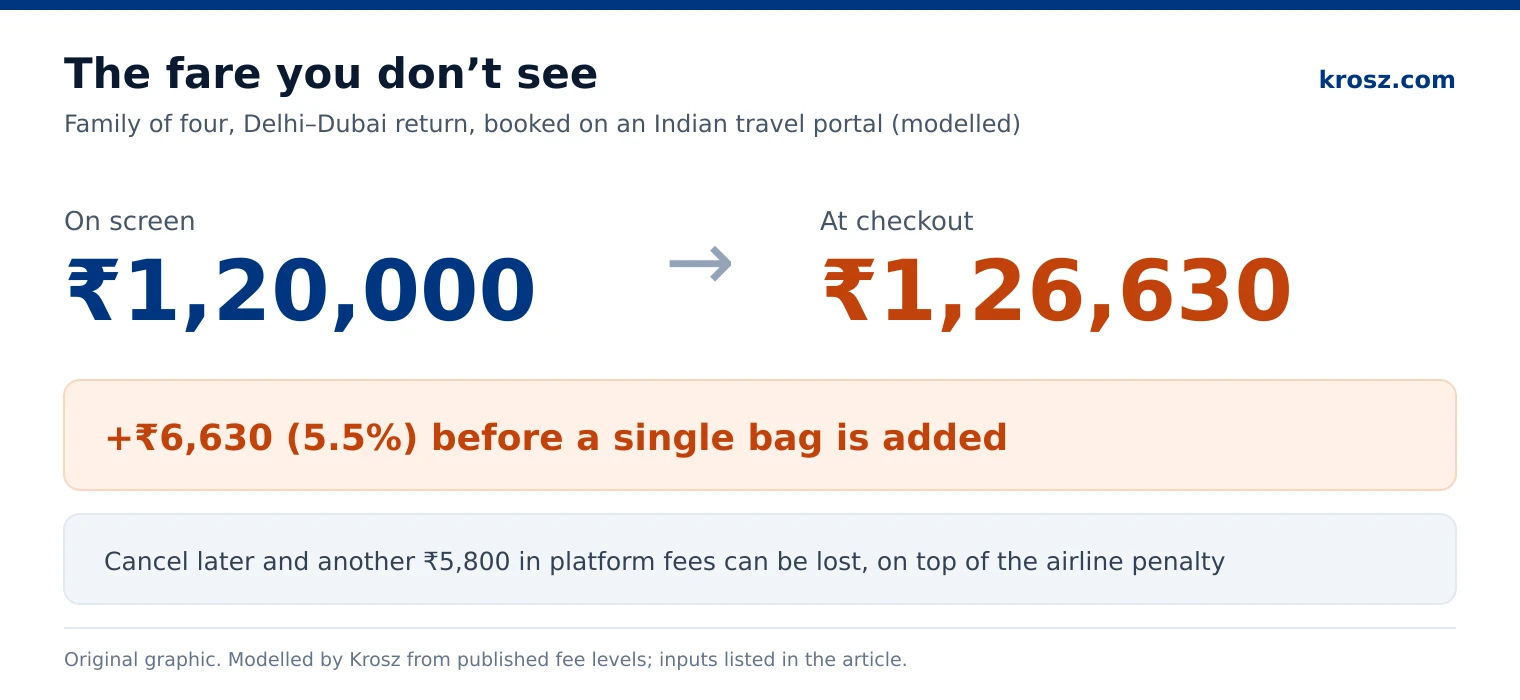
A ₹30,000 ticket to Dubai is rarely a ₹30,000 ticket. For a family of four booking through an Indian travel portal, the price on the search page can climb by roughly ₹6,600 before a single bag is added. If plans change, about ₹5,800 more in agency fees can disappear on top of the airline's own penalty. Almost all of it is legal, disclosed somewhere in the checkout, and invisible at the moment travellers compare prices.
Key findings
Each figure is attributed to its original source. Figures marked modelled are Krosz's own calculations from published fee ranges.
- 8 in 10 Indian flyers say they very frequently meet hidden charges that appear only at the final payment step: convenience fees, seat charges, baggage and add-ons. Only 2% say they never do (LocalCircles survey, 124,000+ responses across 302 districts, via Business Standard).
- ₹25,000–28,000 crore a year is the estimated loss to Indian online shoppers from dark patterns. 63% of online payment users faced hidden charges or drip pricing, up from 52% in 2024 (Datum Intelligence, via Outlook Business).
- ₹100 to ₹900 per passenger is the reported range of OTA convenience fees on flights. One documented international one-way fee was ₹849 per passenger booked directly on Yatra, versus ₹750 for the same booking through HDFC SmartBuy (CardInsider). Paytm's e-tickets list a ₹299-per-passenger Paytm fee on cancellation, on top of the airline's own charge.
- 5.5% on top of the displayed fare (modelled): a family of four on a ₹1,20,000 international return pays about ₹6,630 in convenience, payment and pre-selected add-on charges.
- US$3 to US$15 per flight segment is what airlines typically pay a GDS for each booked segment. At 2.5–3 segments per ticket, that is US$7.50 to US$45 per ticket built into airline distribution costs (AltexSoft).
- US$18.50 to US$24 per booking is the surcharge Lufthansa Group levies on travel agents who book through a traditional GDS instead of its direct NDC connection (travelBulletin).
- US$148.4 billion in global airline ancillary revenue in 2024 (bags, seats, extras), projected to reach US$157 billion in 2025 (IdeaWorksCompany).
- 14 working days is now the deadline for refunds on tickets bought through agents and portals, down from 30, under DGCA rules in force since 26 March 2026. But the rule's cap on cancellation charges excludes agent fees disclosed at booking.
"The fare is the airline's price. The fee stack is the platform's business model, and travellers only see it at the last screen."
Worked example: a family of four flies Delhi–Dubai return
The modelled family pays ₹1,26,630 at checkout for a fare displayed as ₹1,20,000: an extra ₹6,630, or 5.5%. The bridge chart shows where each rupee is added. Every assumption sits inside a published range and is listed below so the maths can be re-run.
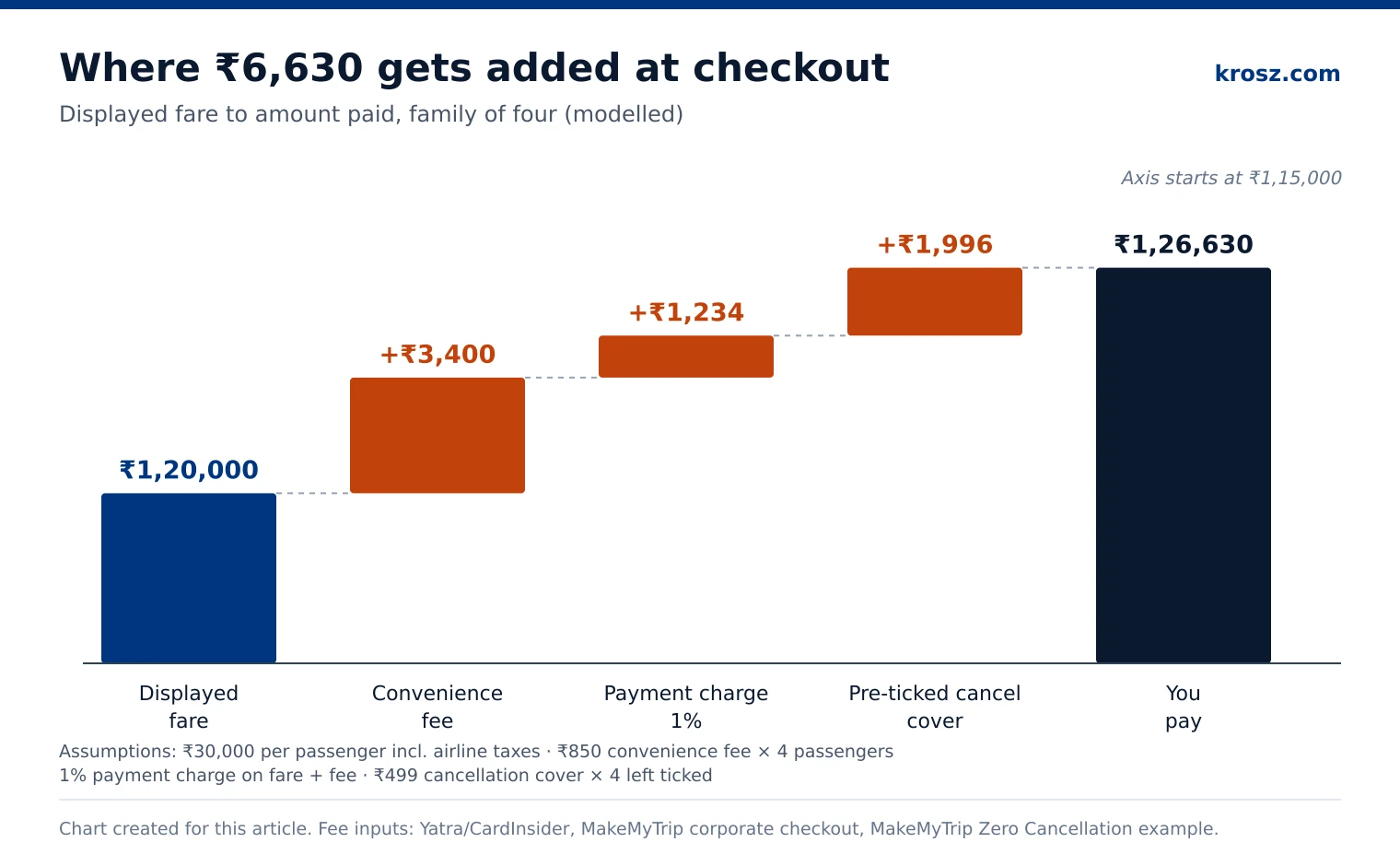
- Displayed fare including airline taxes: ₹30,000 per passenger; 4 passengers; 1 booking.
- OTA convenience fee: ₹850 per passenger, inside the reported ₹100–900 range and close to Yatra's documented ₹849 international one-way fee.
- Payment or "transaction" charge: 1% of fare plus fee, the rate documented on MakeMyTrip's corporate checkout for credit cards.
- Pre-selected cancellation cover: ₹499 per passenger, MakeMyTrip's published example price for its "Zero Cancellation" add-on, counted only if the traveller fails to untick it.
- Not included: seat selection, extra baggage, meals, insurance. Each can add more on international routes.
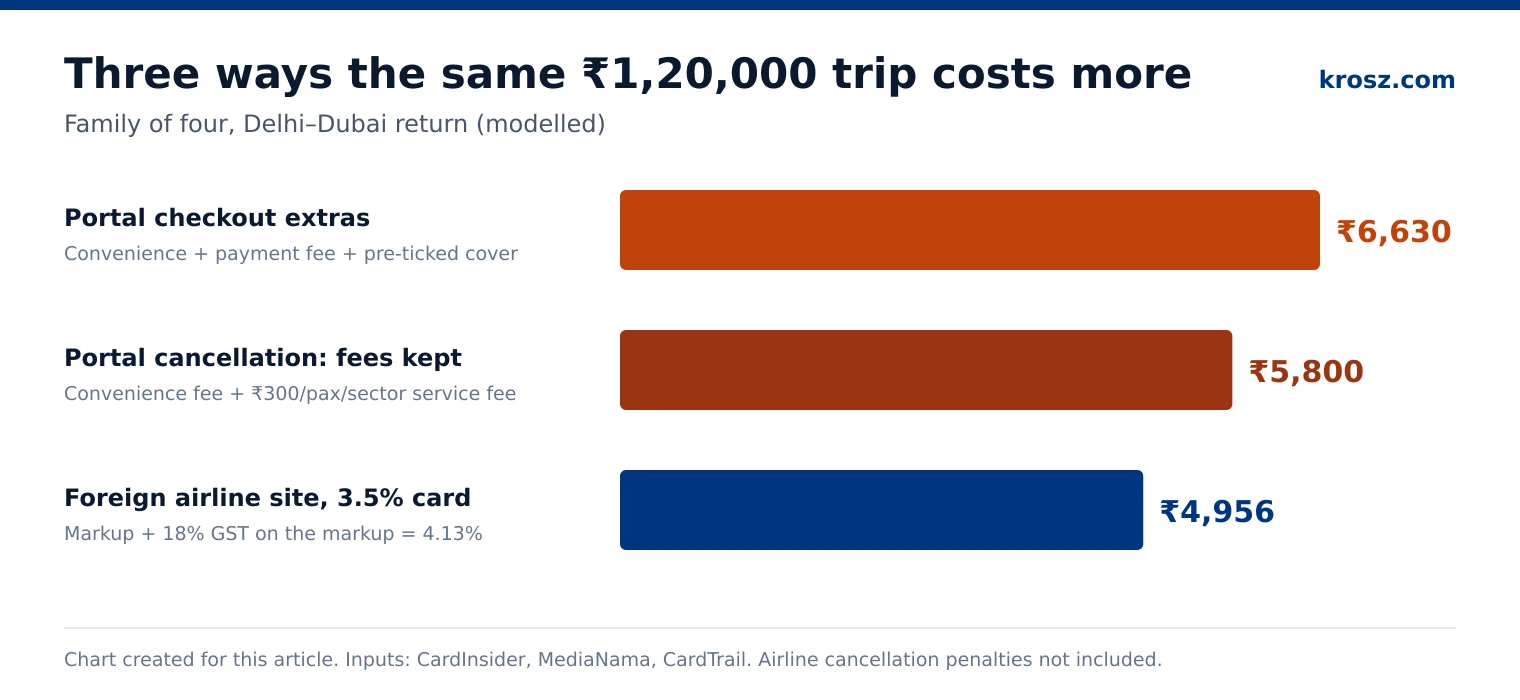
If the family cancels (no cancellation cover bought): OTA cancellation service fees of ₹300 per passenger per sector (a level Cleartrip has charged) come to ₹2,400 for four people on a return trip. Add the ₹3,400 convenience fee, which portals generally do not refund, and ₹5,800 is lost to the platform, separate from and in addition to the airline's own cancellation penalty.
If the family books a foreign airline's website instead, paying in dirhams or dollars on a typical Indian card, a 3.5% forex markup plus 18% GST on that markup adds 4.13%, or about ₹4,956 on ₹1,20,000. Choosing to pay in rupees at the merchant (dynamic currency conversion) usually costs more, not less.
Platform comparison: who charges what
No major Indian portal sells an international ticket at the airline's fare alone; the difference is how much is added and how late it appears. The same booking can even carry a different convenience fee depending on whether the traveller arrives directly, via a bank portal or via a metasearch site.
| Channel | Convenience fee (reported) | Payment / card charges | Cancellation service fee (reported) | Source |
|---|---|---|---|---|
| MakeMyTrip | ₹150–500 per passenger typical; about ₹900 reported on a Bengaluru–Tokyo return | 1% "transaction charge" on credit cards documented on corporate bookings | Sells paid "Zero Cancellation" cover (₹499 in its example); convenience fee not refunded | Live From A Lounge; ICICI Bank |
| Goibibo (MakeMyTrip group) | ₹279 base fee on a domestic one-way plus 18% GST (invoice); Feb 2026 complaint of a percentage fee via HDFC SmartBuy vs flat fee on Goibibo | Bank discounts exclude convenience fee and add-ons | Convenience, meal and baggage fees non-refundable (invoice terms) | Voxya complaint, Feb 2026 |
| Paytm Travel | ₹150–300 per booking reported; past e-tickets show ₹289–319 incl. GST | Wallet and UPI cashback offers | ₹299 per passenger Paytm fee on cancellation, plus airline fee; ₹250 reschedule fee | Paytm e-tickets |
| PhonePe (flights run by ixigo) | Follows ixigo's structure | UPI cashback campaigns | ixigo rules apply | TravelTrendsToday |
| ixigo | ₹100–300 per ticket | — | — | Competitor comparison, May 2026 |
| Yatra | ₹849 per passenger on an international one-way, booked directly | Card offers common | ₹250 per person per segment (historical) | CardInsider |
| Cleartrip (Flipkart group) | ₹100–500 per ticket by route and cabin | Bank discounts, e.g. ICICI 10% off international (capped) | ₹300 per passenger per sector (historical) | Zoutons, Jun 2026 |
| Amazon (flights run by Cleartrip) | Small percentage fee at 2019 launch; ₹340 on a ₹2,000 domestic ticket reported later | Amazon Pay cashback | No Amazon/Cleartrip cancellation fee promised at launch | The Points Guy, 2019 |
| HDFC SmartBuy (via Yatra / Cleartrip / Goibibo) | Up to ₹860 per passenger on international; ₹750 for the same Yatra one-way | — | Per partner's rules | CardInsider |
| EaseMyTrip | Markets zero-convenience-fee fares on selected bookings; a fee can apply via bank portals | Co-branded card discounts | — | Competitor comparison, May 2026; user reports |
| Akbar Travels | Weekly "zero convenience fee" promotion, implying a fee on other days | Non-refundable convenience fee plus GST noted at checkout | — | Akbar Travels offer page |
| Airline website (IndiGo, Air India) | IndiGo direct fee reported at ₹149 on a domestic booking | Air India's agent policy lists a 2% credit-card surcharge | Airline fees only; 48-hour free look-in applies to direct bookings | Air India agent policy |
| Foreign airline website, foreign currency | None from an Indian agent | 1–3.5% card forex markup plus 18% GST on the markup | Airline fees only | CardTrail |
Payment apps resell someone else's engine. PhonePe's flights are powered by ixigo (since June 2024) and Amazon's by Cleartrip; Paytm runs its own travel business. So the fee on a payment app is set by the OTA behind it, and it can differ from the same OTA's own website.
How to read the table. Fee levels change by route, cabin, passenger count, payment method and promotion, often week to week. Ranges marked "historical" show the structure of the fee, not today's exact amount. A dash means no reliable public figure was found; it does not mean the fee is zero.
- Per passenger, not per booking. Convenience fees multiply with every traveller and, on some sites, every leg.
- Last-screen disclosure. Fees typically appear only after passenger details are entered, when switching sites is most costly.
- Non-refundable by design. The convenience fee is usually kept even when the airline refunds the fare.
How travel companies get their fares
Portals do not set international fares. They resell fares that airlines file, reached through one of a few pipes, and they earn from both ends: incentives on the airline side and fees on the traveller side.
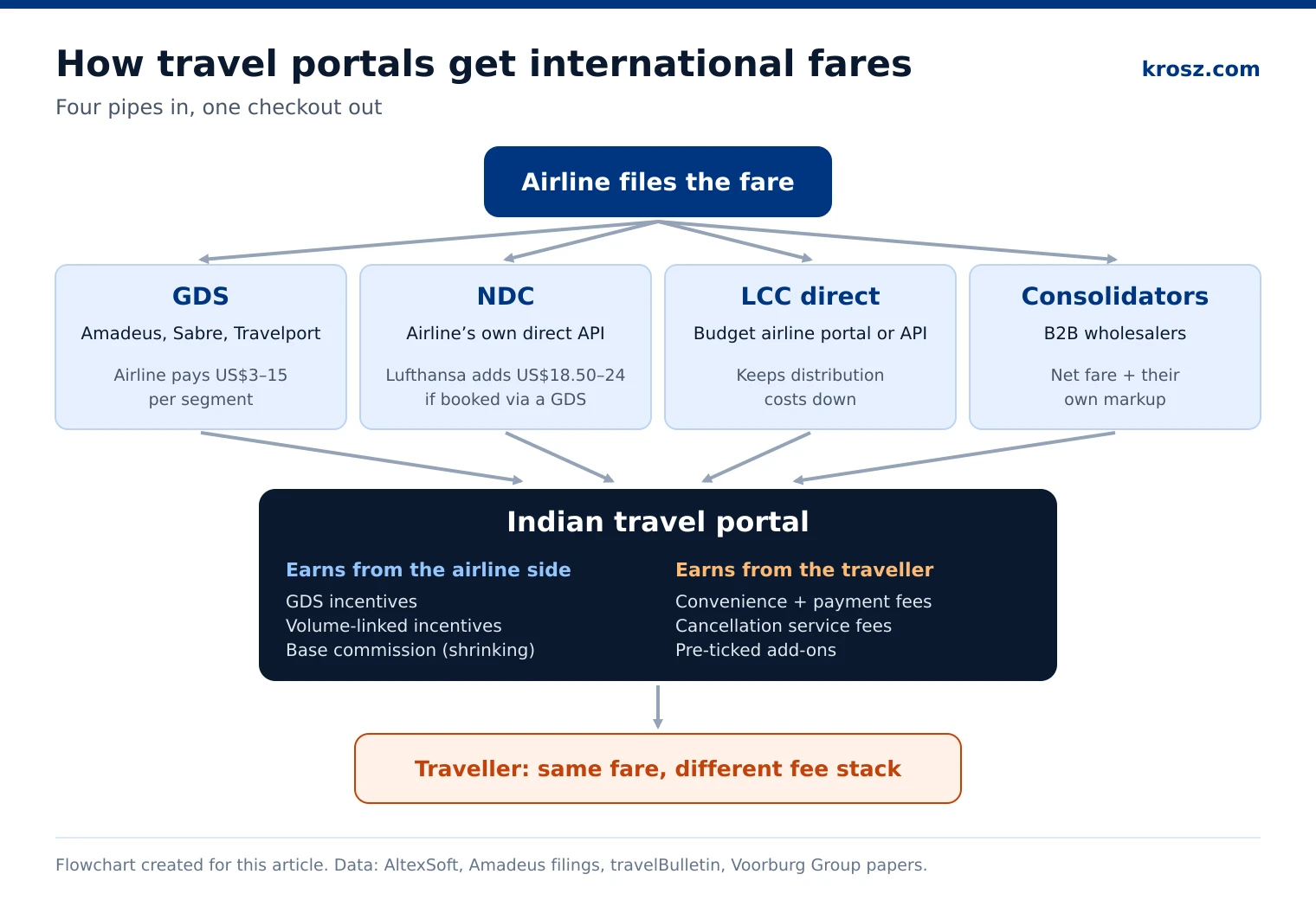
- Global Distribution Systems (GDS): Amadeus, Sabre, Travelport. Airlines load fares, seat availability and rules; agencies search and ticket through the GDS. The airline pays the GDS a flat fee per booked segment, typically US$3 to US$15, and the GDS passes part of it back to agencies as incentives. Amadeus handled 484.5 million travel agency bookings in 2025 and earned €3,119.2 million in Air Distribution revenue, about €6.44 per booking by Krosz's calculation (Amadeus FY2025 results). Air India told Parliament it pays GDS vendors a fixed charge per segment, settled monthly through the IATA clearing house (Lok Sabha, 2009).
- NDC: the airline's own direct connection. IATA's XML standard lets airlines sell straight to agencies, with fare bundles and extras the GDS cannot show. Air India became the first Indian airline to implement NDC in September 2024 (Air India). Airlines push agencies toward NDC with GDS surcharges, and NDC is also an upselling channel: on one vendor's platform up to 31% of NDC bookings carried a paid extra (Travolution / Accelya).
- Direct APIs from low-cost carriers. Budget airlines have historically sold direct to keep distribution costs down and connect large portals through their own APIs.
- Consolidators and B2B wholesalers. In this "merchant model" the seller negotiates a net price, adds its own markup and settles with the customer itself; in the "agent model" it earns a commission instead (Voorburg Group).
Where portal revenue comes from
- Airline side: base commissions (which Indian airlines have steadily cut), volume-linked incentives and GDS incentives.
- Traveller side: convenience fees, payment charges, cancellation and amendment service fees, and paid add-ons such as cancellation cover and insurance.
- Partner side: bank and card incentives and on-platform advertising.
- Scale: MakeMyTrip reported US$407.1 million in air ticketing adjusted margin for FY26, up 13.4% in constant currency (India Outbound). International air accounted for 43% of that segment's adjusted margin in Q3 FY26 (Motley Fool transcript).
The consequence for travellers: two portals selling the same seat usually see the same airline fare. What differs is the fee stack layered on top, bank-funded discounts, and occasionally a negotiated fare.
Regulation: India is tightening, the US has stepped back
India now has binding rules against drip pricing and slow refunds, but penalties so far total about ₹20 lakh across nine platforms, small next to fee revenue. In the US, the federal rule that would have forced airlines and OTAs to show bag and change fees up front was struck down in 2026.
| Date | Jurisdiction | Measure | What it means for hidden charges |
|---|---|---|---|
| Aug 2026 | India — CCPA | Penalties on nine platforms including IndiGo, SpiceJet, Zepto, BookMyShow; about ₹20 lakh collected | Handling fees treated as drip pricing; auto-added memberships as basket sneaking (Outlook Business) |
| 2 Jul 2026 | United States — DOT | Withdrawal of the 2024 ancillary-fee disclosure rule takes effect | Listings need only say extra fees may apply (TravelNews) |
| 26 Mar 2026 | India — DGCA | Revised refund CAR in force (issued 24 Feb 2026) | 48-hour free look-in; agent/portal refunds within 14 working days; statutory taxes refundable; cancellation cap excludes agent charges disclosed at booking (SCC Online) |
| 3 Feb 2026 | United States — 5th Circuit | Vacates the DOT ancillary-fee rule | DOT had said the rule could save passengers about US$500 million a year (Bloomberg Law) |
| Dec 2025 | India — CCPA | Zepto fined ₹7 lakh | Drip pricing and basket sneaking |
| Sep 2025 | India — CCPA | FirstCry fined ₹2 lakh | First major drip-pricing penalty |
| 30 Nov 2023 | India — CCPA | Guidelines for Prevention and Regulation of Dark Patterns, 13 banned practices | Drip pricing defined; pre-added travel insurance cited as an example (Bar & Bench) |
| 27 Sep 2019 | India — IRDAI | Ban on travel portals selling insurance through pre-checked boxes | First regulator to target a travel-checkout dark pattern |
The gap to note: the DGCA cancellation cap protects the fare, not the platform fee. A portal's convenience fee and cancellation service fee fall outside the cap as long as they were shown at booking. Reports also say the 48-hour look-in applies only to tickets bought directly on the airline's website (Wego), a reading worth confirming with DGCA.
What travellers can do
Compare the final payable amount for all passengers, never the search-page fare.
- Run each site to the payment screen before choosing; fees appear only after passenger details are entered.
- Multiply per-passenger fees by travellers and legs; a ₹500 fee is ₹4,000 for a family of four on a return trip.
- Untick pre-selected extras (cancellation cover, insurance, seats) unless you want them; under CCPA rules pre-added items are a banned dark pattern.
- Check the airline's own site. Direct bookings get the DGCA 48-hour free cancellation window and avoid portal service fees.
- Pay foreign sites in their currency with a low- or zero-markup card, and decline offers to be charged in rupees.
- Know the refund clock: 14 working days for portal bookings since 26 March 2026; complaints can go to the National Consumer Helpline (1915).
Flying to Dubai or beyond? Sort the visa first: check Dubai visa requirements on Krosz, where the service fee is shown in full before you pay.
Methodology and limitations
This report compiles publicly available data as of 12 October 2026: regulator notices, parliamentary replies, company filings and earnings calls, airline policy pages, industry surveys and press reports. It is desk research, not a live checkout audit.
- Modelled figures (the family-of-four example, €6.44 per Amadeus booking, US$7.50–45 per ticket) are Krosz's arithmetic on the cited inputs and are labelled as such.
- Fee ranges vary by route, cabin, passenger count, payment method, promotion and entry route, and change frequently. Quote ranges, not single values, unless citing a dated example.
- Source quality differs. Some platform fee ranges come from comparison posts published by a competing zero-fee booking site (HappyFares), a traveller-advice site and a user forum (TechnoFino). Treat these as indicative.
- Historical figures (2012 cancellation service fees) show fee structure, not current levels.
- Survey figures (LocalCircles, Datum Intelligence) are self-reported and opt-in.