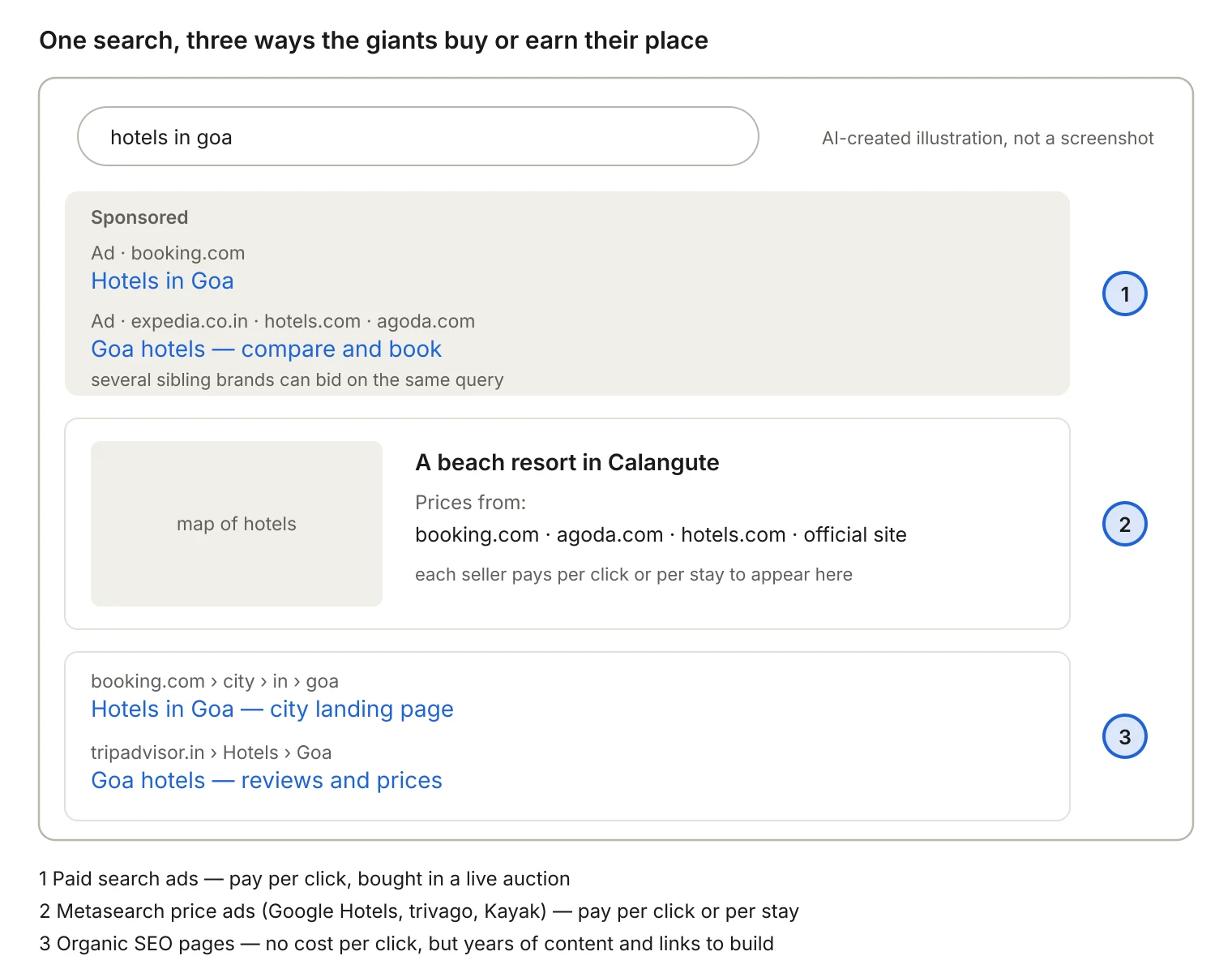
Last night someone typed "hotels in Goa" into Google. Before the results loaded, an auction ran in milliseconds, and the winners were almost always the same two companies.
In 2025, Booking Holdings and Expedia Group spent about $15.5 billion on marketing, roughly $42 million every day. Together they processed $305.7 billion of travel bookings. They own no hotels. They own every door a traveller walks through.
This guide shows how the machine is built, how it buys and earns traffic, how a small player can still rank, which "get rich" tricks get people banned or sued, and where to watch all of it yourself for free. Real screenshots of these brands' pages are not reproduced here: every visual is a diagram or illustration made for this article and tagged as such.
1. Who owns what: two parents behind the brands you think are rivals
Expedia, Hotels.com, Orbitz and Travelocity look like competitors on Google. They are siblings. Expedia Group bought Orbitz and Travelocity in 2015 and Wotif in 2014, and since late 2021 has pushed three core brands, Expedia, Hotels.com and Vrbo, above the rest. It is still pruning: Lastminute.com.au closed on 2 June 2026 and its traffic now goes to Expedia. On the other side, Booking Holdings owns Booking.com, Kayak, Priceline, OpenTable and Agoda.
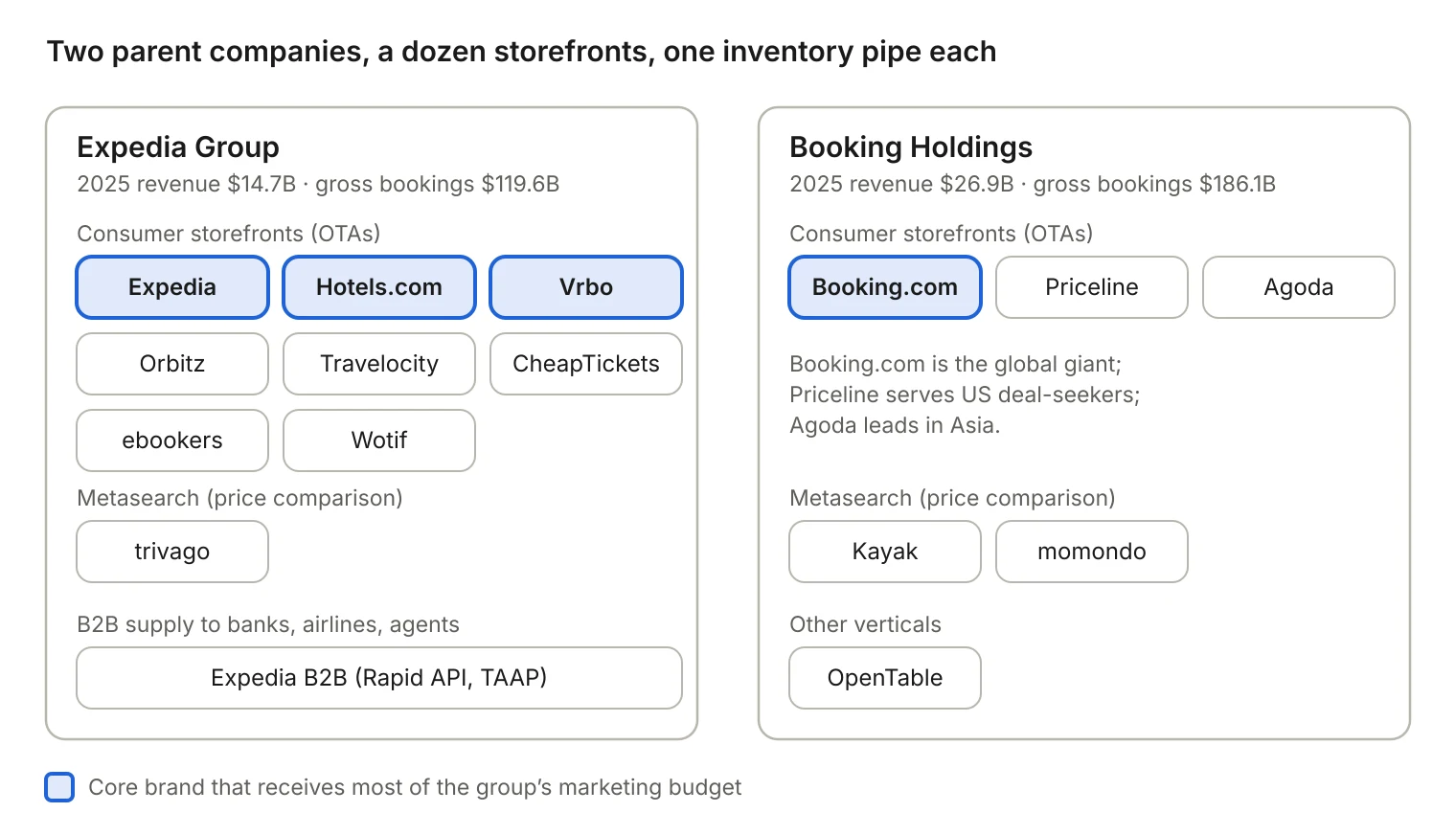
Each parent runs one hotel database, one payments system and one tech platform, then dresses it up as several storefronts aimed at different customers (deal hunter, loyalty member, Asia traveller, villa renter). The storefronts bid in the same ad auctions, so the group can hold several positions on one results page.
Real example: the same room on the same dates is typically priced within a narrow band on Orbitz, Expedia and Hotels.com, because the brands are not competing on inventory access. What differs is the loyalty scheme and the marketing.
2. By the numbers: marketing is their single biggest cost
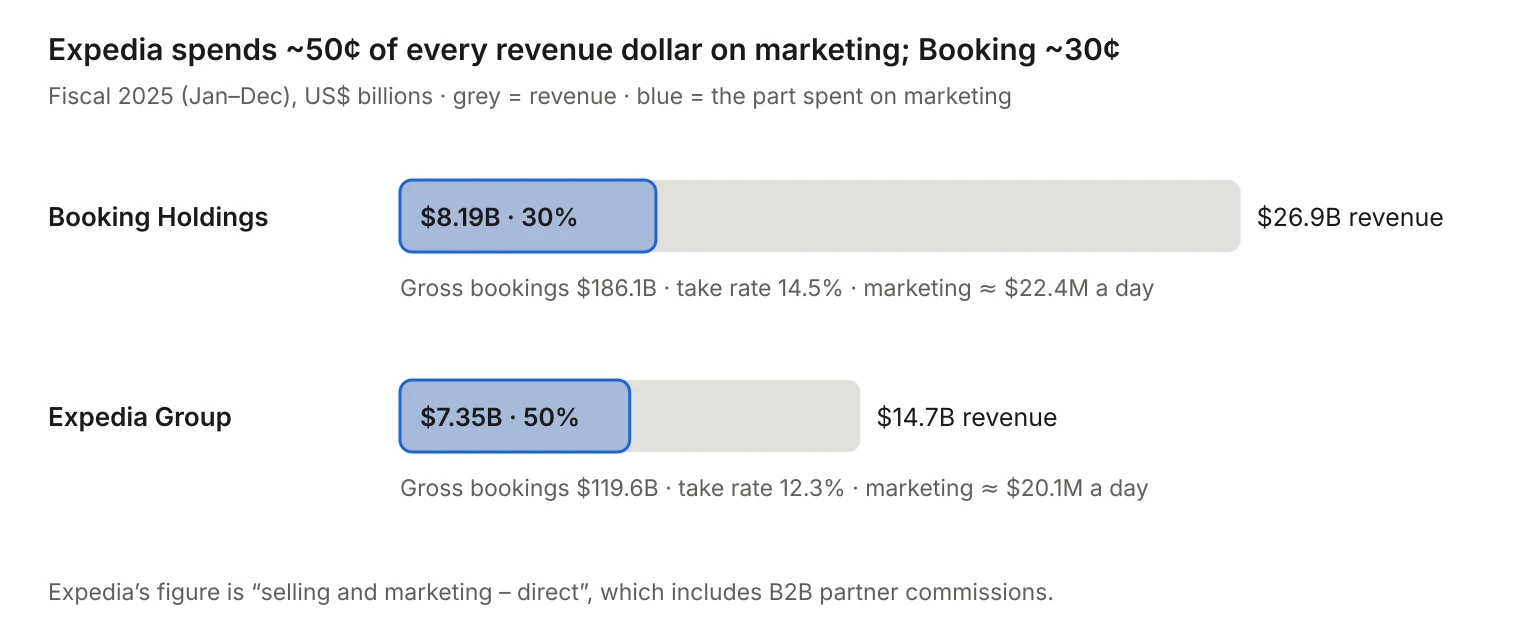
The take rate is the slice of each booking the platform keeps as revenue. Out of that slice, a third (Booking) to a half (Expedia) goes straight back out to Google, metasearch sites, affiliates and TV. That is why a cheaper click or a returning customer matters so much to them.
| 2025 fact | Booking Holdings | Expedia Group |
|---|---|---|
| Room nights booked | 1.235 billion (+8%) | 94 million in Q4 alone (+9%) |
| Bookings made directly (no paid click) | Mid-50s % of room nights; B2C direct mid-60s % | About two-thirds of bookings start on its own brands |
| Booked on the mobile app | Mid-50s % of room nights | Not disclosed |
| Loyalty engine | Genius levels 2–3: 30%+ of travellers, mid-50s % of room nights | One Key, shared across Expedia, Hotels.com, Vrbo |
| Fastest-growing line | Flights: 68M tickets, +37% | B2B bookings +24% in Q4 |
3. How one hotel room is sold on 20+ platforms at once
A hotel does not log into 20 websites. It updates one system, and a channel manager pushes that room to every storefront, comparison site and partner portal in seconds.
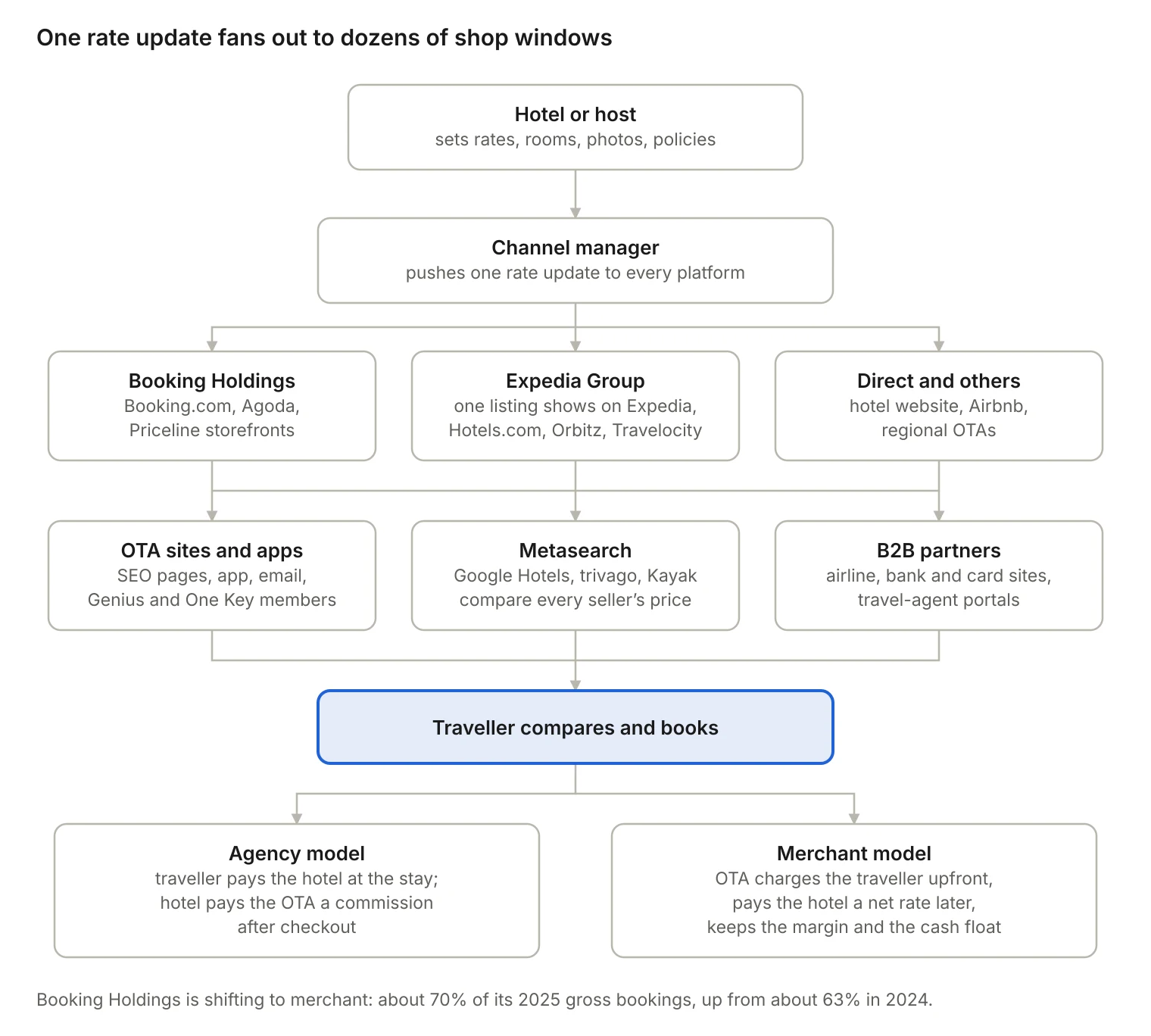
How the money moves. In the agency model the OTA earns a commission (commonly in the mid-teens to mid-20s percent of the room price; it varies by contract and visibility programme). In the merchant model the OTA takes your card at booking, holds the cash and pays the hotel later. Booking's merchant gross bookings grew 25% to $130 billion in 2025: merchant lets it control payments and add flights and attractions to the same basket.
Real example, Expedia's multi-brand reach: a hotel that signs one Expedia Group contract appears on Expedia, Hotels.com, Orbitz, Travelocity, ebookers and Wotif, and its rate can travel through Expedia's B2B channel to airline and bank booking sites. That channel is Expedia's growth engine, with B2B gross bookings up 24% to $8.7 billion in Q4 2025.
4. Paid channels: renting the traveller's attention
Paid marketing is the bulk of the bill, and most of it goes to one company: Google. Booking has told investors it uses Google to generate a significant portion of its traffic, mainly through pay-per-click campaigns.
| Paid channel | How it works | Real example |
|---|---|---|
| Search ads (PPC) | Bid on "hotels in [city]", "cheap flights to [city]" and even hotel names; pay only when clicked | Back in 2017 Booking reported $4.1B of performance advertising, mostly search engines; in 2019 Expedia spent about $5B on advertising |
| Metasearch | Send live prices to Google Hotels, trivago, Kayak, Tripadvisor; pay per click or a commission per stay | Each giant owns a metasearch site (Expedia–trivago, Booking–Kayak), so some spend stays in the family |
| Affiliates and partners | Bloggers, creators, airlines and banks link to the OTA and earn a commission | Expedia's 2025 direct marketing rose $503M, mainly from B2B partner commissions |
| Brand: TV, video, social | Make you type the brand name next time instead of clicking an ad | Booking raised brand and social media spend in Q4 2025 |
The efficiency game. The aim is to spend less per booking. In Q4 2025 Expedia's consumer brands cut direct marketing 5% to $847M while consumer bookings still grew 5%, taking marketing from 5.1% to 4.6% of B2C gross bookings. Booking runs at about 4.5% of gross bookings.
5. Organic channels: owning the traveller instead of renting them
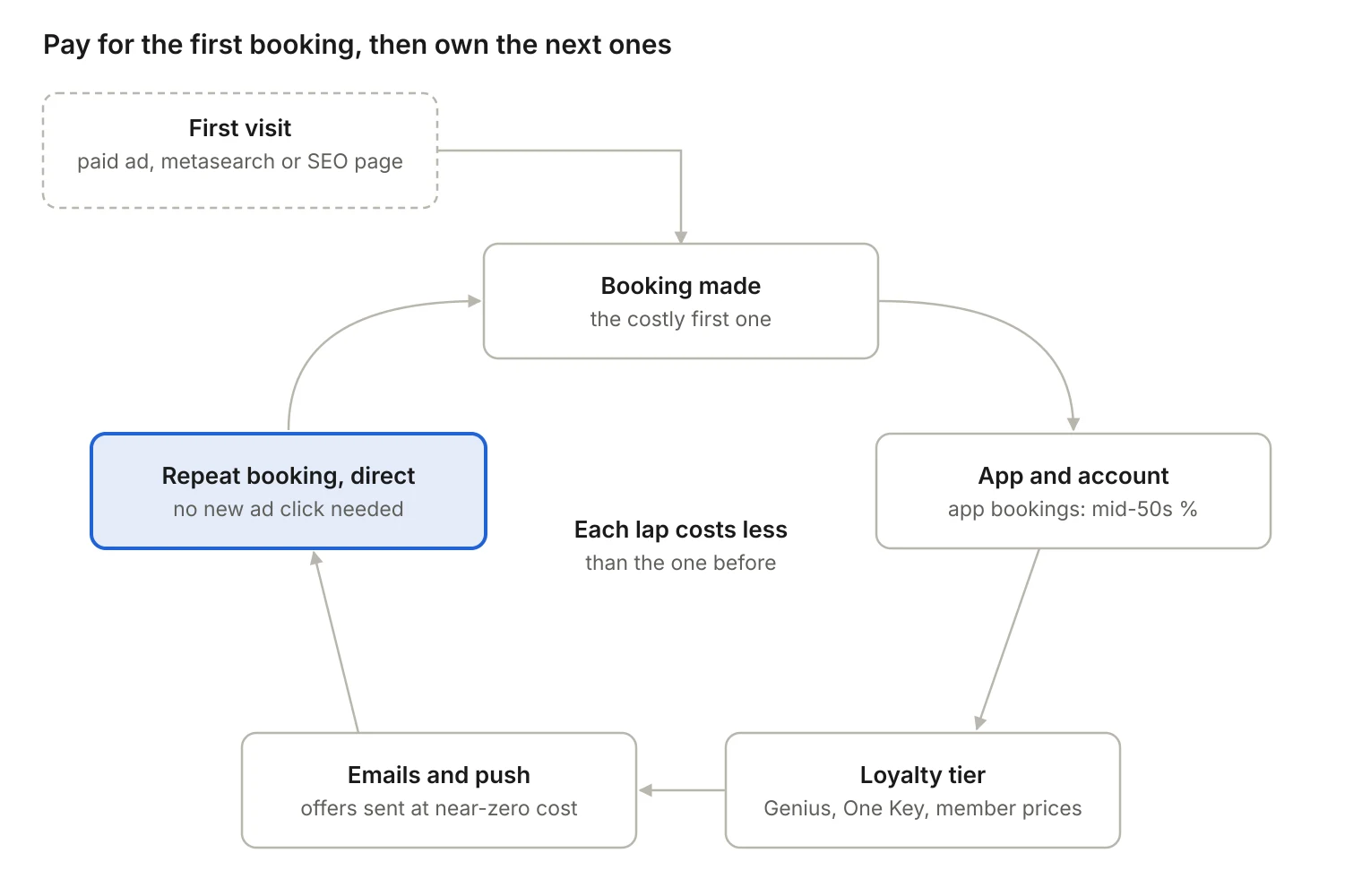
The real prize is the booking nobody paid a click for. In January 2026, 53.7% of visits to booking.com came direct (people typing the name or opening the app), against about 12% from Google. Expedia says roughly two-thirds of its bookings start on its own brands.
| Organic lever | What they do | Real example |
|---|---|---|
| SEO landing pages at scale | One templated page for every city, area, landmark and hotel type, filled with live prices, photos and reviews | "Hotels in Goa", "Hotels near Calangute Beach", "Pet-friendly hotels in Goa": thousands per country |
| Reviews | Only verified guests can review, so every stay adds fresh, unique text | Verified-stay reviews are why OTA pages often outrank the hotel's own site |
| Loyalty | Discounts funded largely by hotels keep members coming back | Genius levels 2–3 book a mid-50s % of room nights; Expedia's One Key spans three brands |
| App | Push alerts and saved trips; no search engine in between | Mid-50s % of Booking's room nights are booked in its app |
| Payments and co-brand card | Keep travellers in their own wallet | Booking.com launched a US Genius Rewards Visa card in 2025 |
| AI search | Make sure the brand shows up inside chatbots and AI answers | Expedia says it is working with major AI platforms to stay visible |
Lesson for smaller players: the giants treat paid ads as a customer-acquisition cost and loyalty, app and email as the profit engine. Copy the loop, not the budget.
6. How you can rank on top (without a billion-dollar budget)
You cannot outspend these companies on Google. You can out-convert them on their own platforms and out-niche them on search.
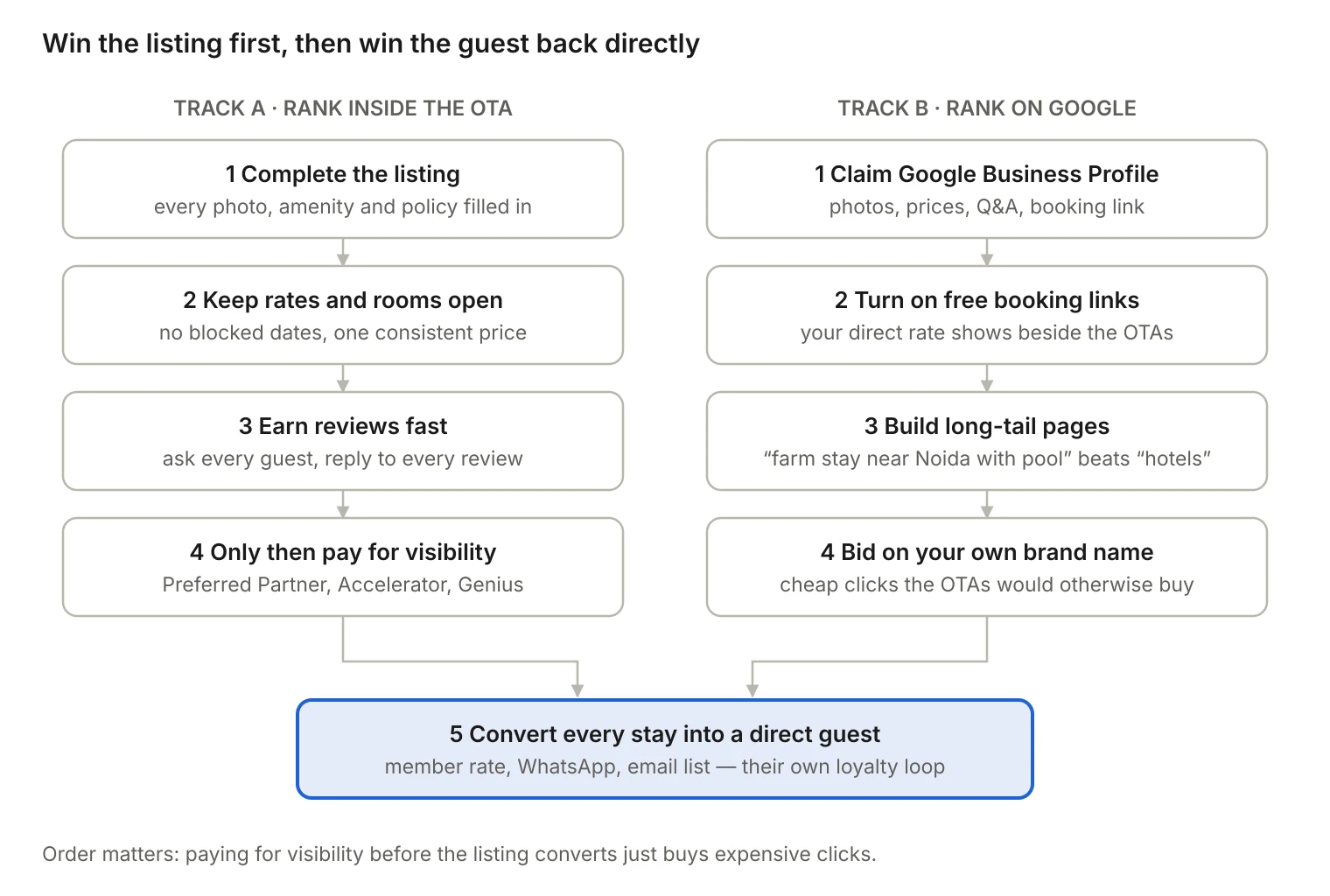
What the OTA algorithms reward. Booking.com and Expedia rank properties largely on how likely a listing is to turn a view into a paid, non-cancelled stay, because that is how they get paid:
- Conversion signals: strong photos, a clear total price, flexible cancellation.
- Availability: open dates and the same price as elsewhere.
- Review score and volume: recent reviews count more than old ones.
- Commission level: paid programmes (Booking's Preferred Partner and Visibility Booster, Expedia's Accelerator and TravelAds) buy extra placement for a higher commission. Use them as a booster, not a crutch.
What Google rewards. Specific answers to specific questions. A big OTA has a page for "hotels in Goa"; it rarely has a genuinely useful page for "family farmhouse near Noida with pool and lawn for 30 guests". That gap is where small brands win.
The direct-booking rule: accept that the OTA paid to find this guest, then earn the next stay. Once guests arrive, give them a reason (member rate, free breakfast, WhatsApp concierge) to book you directly next time.
7. The "big money" tricks, and why to stay away
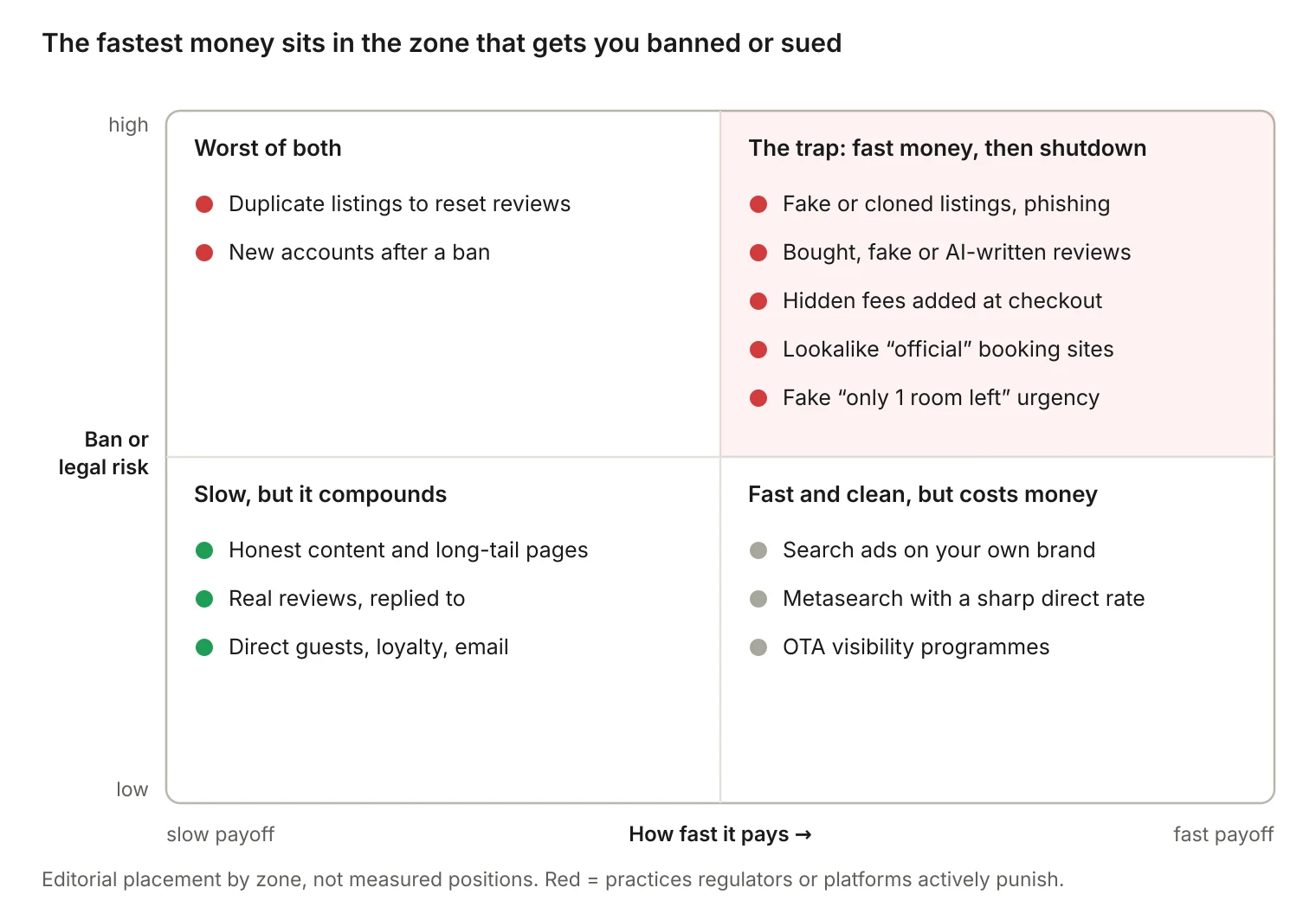
Every shortcut below works for a few weeks. Each is now a crime, a regulated offence or an automatic ban on the platforms. They are explained so you can recognise and avoid them.
| Trick | Why people try it | Why it ends badly |
|---|---|---|
| Fake or cloned listings, phishing guests | Copy a real property's photos or hijack a hotel account and message guests for payment | Booking.com's security chief reported scams up 500–900% in 18 months; Dutch reports jumped to 957 in H1 2026 from 162 in H2 2025. This is plain fraud |
| Lookalike "official" booking domains | Catch people searching a brand name | Over 39,000 vacation-related domains were registered in May 2025, 1 in 21 flagged malicious |
| Fake, bought or AI-written reviews | Reviews drive ranking and conversion | US FTC rule since Oct 2024: up to $51,744 per violation. India's IS 19000:2022 sets review-verification rules for travel portals |
| Drip pricing | A low "from" price wins the comparison click | US junk fees rule since 12 May 2025 requires the total price up front; India's CCPA dark-pattern guidelines ban drip pricing |
| Fake scarcity ("only 1 room left!") | Panic converts | Named as "false urgency" in the same CCPA guidelines, with hotel booking given as an illustration |
The pattern: each trick borrows trust it did not earn. Platforms now use AI to detect and remove fake listings before they take bookings, so the window keeps shrinking.
8. Multiple-listing tricks: why they work for a month, not a year
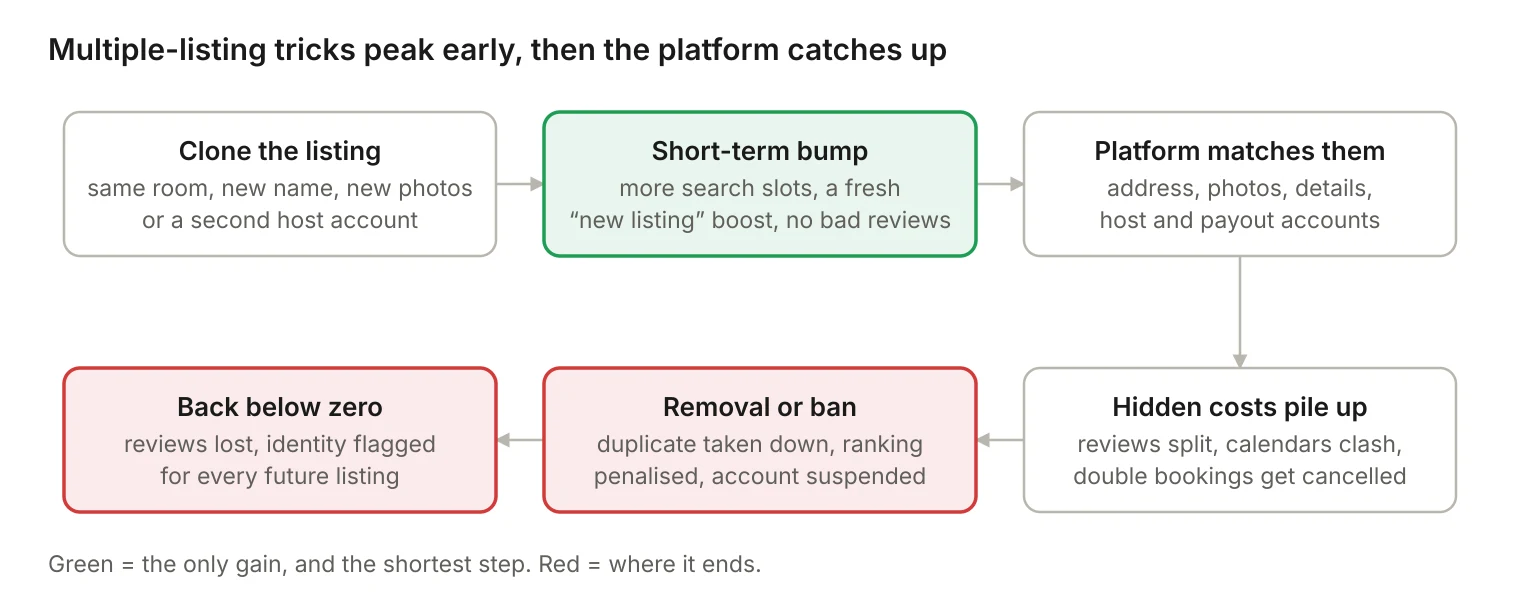
More listings means more search slots means more bookings. The platforms know this and built detection specifically to stop it.
| Multiple-listing trick | What actually happens |
|---|---|
| Same unit listed as several "properties" | Platforms compare address, photos and details; hosts report even small similarities trigger a duplicate review |
| Relisting to wipe bad reviews | Airbnb removes duplicates of a listing that had issues, a rule hosts say exists because people re-created listings after every bad review |
| Extra host accounts to dodge limits | Airbnb's "One Host, One Home" sweeps removed 2,233 New York listings (2016) and 524 in Portland (2017) |
| Several ad accounts to fill Google | Google's Unfair Advantage policy allows only one ad per business in each ad location; multi-account setups get a warning, then suspension |
| Every OTA, no channel manager | Calendars fall out of sync, rooms get double-sold, guests get cancelled, and cancellations hurt OTA returns, so they penalise the property |
What to do instead: list each real unit once, put room types inside one property, and use a channel manager to be on many platforms legitimately. That is exactly what the giants do with their own brands: one inventory, many shop windows, no fake duplicates.
9. Where you can see all of this yourself (free)
| Tool | What you can see | Try this |
|---|---|---|
| Google Ads Transparency Center | Every Google search, YouTube and display ad an advertiser runs, by country | Search "Booking.com" or "Expedia", set region to India, scroll their live ads |
| Meta Ad Library | All active Facebook and Instagram ads for any page | Look up Booking.com, Agoda and MakeMyTrip side by side |
| Google Hotels | Which sellers pay to show a price for each hotel | Open any Goa hotel and note who appears under "prices from" |
| Semrush / Similarweb free pages | Traffic sources, top organic keywords, competitors | Compare booking.com with hotels.com and agoda.com |
| SEC EDGAR | Annual 10-K reports with marketing spend, risks, strategy | Open Booking's or Expedia's latest 10-K and search "marketing" |
| Wayback Machine | How a page looked in past years | Watch how a "hotels in [city]" landing page grew over a decade |
| Airbnb Community | Real host cases of duplicate-listing removals | Search the forum for "duplicate listing" |
A 10-minute exercise: Google one city plus "hotels", count how many paid, metasearch and organic slots belong to Booking Holdings or Expedia Group brands, then check the same brands in the Transparency Center.
Building a travel business? Where Krosz fits
The giants win by putting one inventory behind many shop windows. Krosz gives agencies and companies the same kind of plumbing for visas: a B2B visa portal with your own markup and branding, with flights and hotels being added. Talk to the Krosz for Business team →
Sources: Booking Holdings and Expedia Group 2025 earnings releases and Form 10-K filings, plus the reporting linked above. Figures are fiscal 2025 (Jan–Dec 2025). Commission ranges are a general industry norm; check your own OTA contract. Last checked on 12 October 2026.