India Renames the Tourist Visa and Cuts Visa Categories to 9: What It Means for Indian Families and Businesses (November 2026)
India’s visa overhaul announced on 11 November 2026 explained for Indian readers: the new Visitor Visa (V-1 for 30 days, V-2 for 1, 5 or 10 years), one-year multiple-entry medical visas with attendant visas, S-1 and S-2 student visas, the B-2 Production Investment e-Visa for foreign technicians, the Miscellaneous Visa for people of Indian origin and their spouses or children, and the end-2026 start date.
Krosz Visa Desk · Updated 2026-11-13 · 7 min read
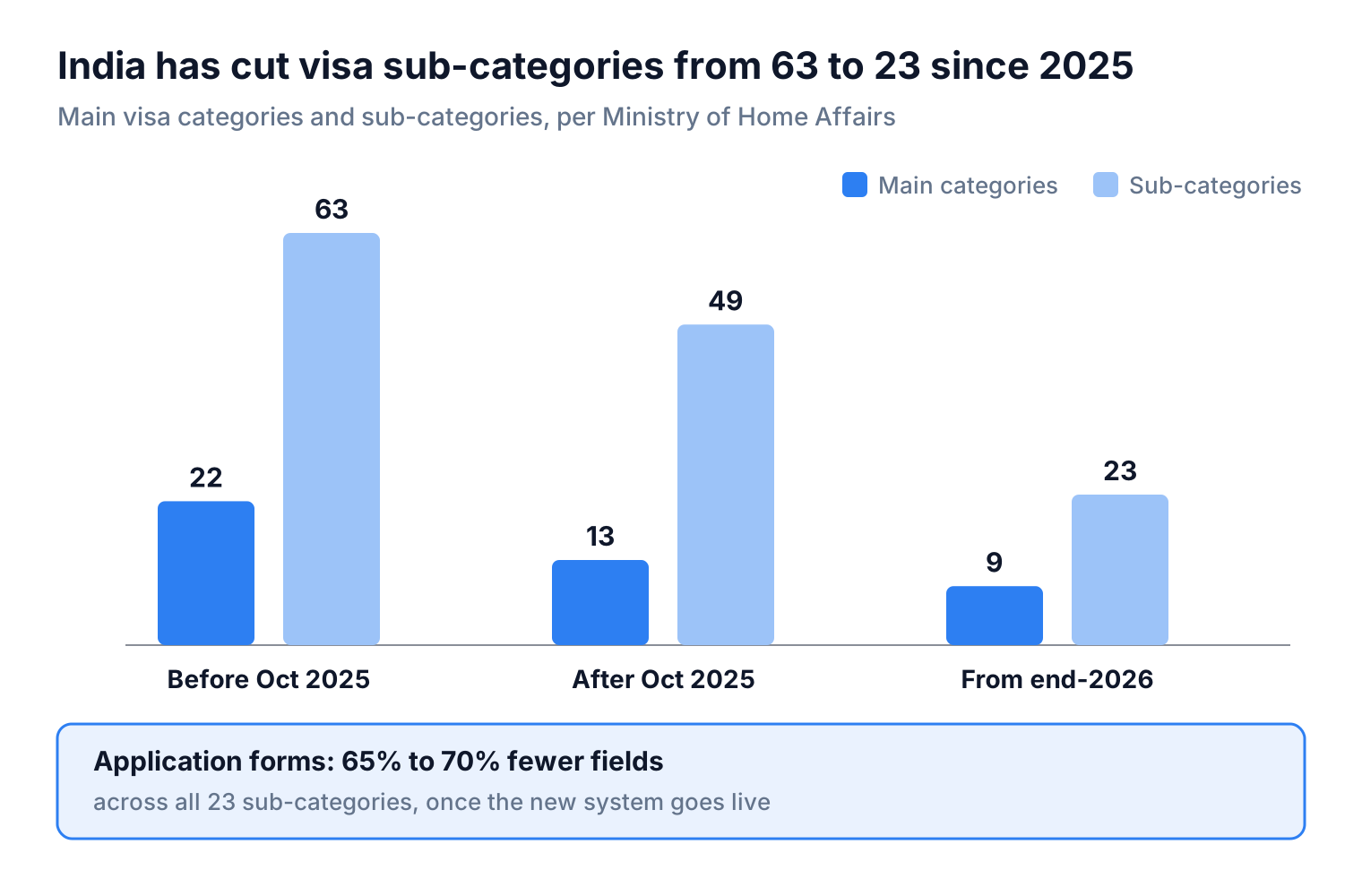
India has announced its biggest visa clean-up in a year. On 11 November 2026, the Ministry of Home Affairs said it has cut the main visa categories from 13 to 9 and sub-categories from 49 to 23, renamed the Tourist Visa as the Visitor Visa, and reduced the fields on application forms by 65% to 70%. The new framework is due to go live by the end of 2026. These rules govern foreigners coming to India, so they matter most to Indian families with foreign relatives, hospitals and their patients, universities, and companies that bring in overseas engineers.
*Information checked on 13 November 2026.*
The quick take
- 9 main categories, 23 sub-categories: Business, Diplomatic, Work, Journalist, Medical, Official, Student, Visitor and Miscellaneous.
- Tourist Visa becomes Visitor Visa: V-1 for 30 days with multiple entries; V-2 with validity of 1, 5 or 10 years.
- Medical visas: M-1 and M-3 granted for one year, multiple entry by default, with M-2 and M-4 for attendants.
- Foreign technicians: a B-2 Production Investment Business Visa via e-Visa replaces the old e-B4.
- Shorter forms: 65% to 70% fewer fields across all 23 sub-categories.
- Not live yet: visas under the new system are expected by end-2026; use current categories until then.
- Indians going abroad: nothing changes for your own outbound visas.
At a glance
| Area | What is new | Who in India it touches | What to do |
|---|---|---|---|
| Visitor Visa (was Tourist) | V-1: 30 days, multiple entry; V-2: 1, 5 or 10 years | Families inviting foreign relatives and friends | Keep using current visa types until the portal changes |
| Medical Visa | M-1 / M-3 for 1 year, multiple entry; M-2 / M-4 for attendants | Hospitals, AYUSH centres, patients’ families | Plan follow-up visits within one visa |
| Student Visa | S-1 for courses; S-2 for PhD, research, internships; e-S1 up to 5 years | Universities and Study in India admissions | Match the course type to S-1 or S-2 |
| Business Visa | B-1 long-term ventures; B-2 short-term, incl. Production Investment e-Visa | Companies hiring foreign engineers or hosting conferences | Brief HR and travel desks on B-1 vs B-2 |
| Miscellaneous Visa | Covers persons of Indian origin and their spouses or children, and more | Indians with foreign-national spouses or children | Check eligibility once the new categories go live |
| Application forms | 65% to 70% fewer fields | Every foreign applicant | Fill forms carefully; checks still apply |
What the Home Ministry announced
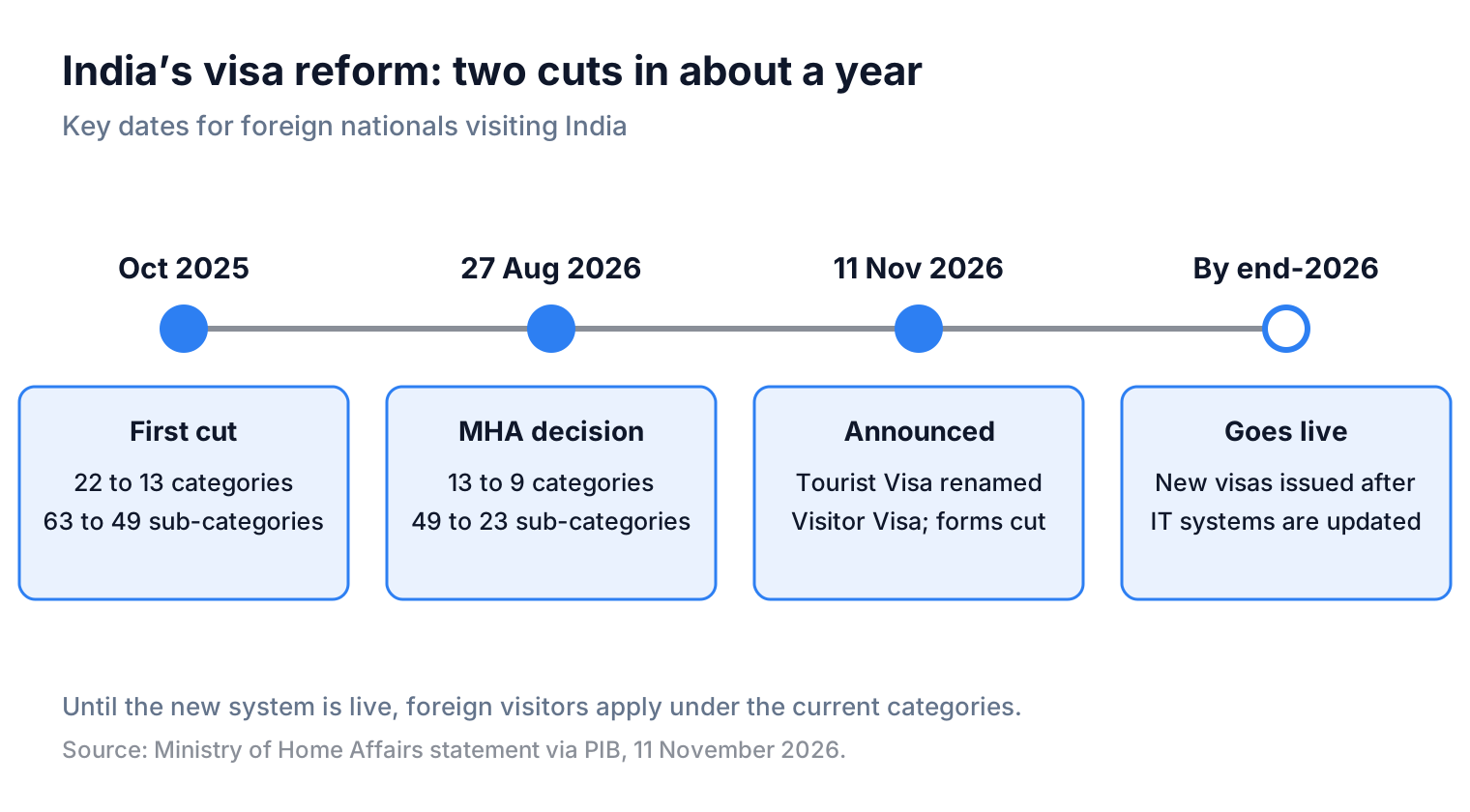
What changed: the Ministry took the decision on 27 August 2026 and made it public on 11 November 2026. It is the second round of trimming in about a year. In October 2025, India had already cut its main visa categories from 22 to 13 and sub-categories from 63 to 49. The Ministry says it studied visa systems in developed countries and global standards, and grouped similar travel purposes together so applicants can pick the right visa more easily.
Effective date: the Ministry is upgrading its IT systems and says visas will be granted under the new framework by year-end. No exact date has been given. India’s e-Visa, currently available to nationals of 172 countries under 13 sub-categories, continues as it is until then.
The new Visitor Visa: V-1 and V-2
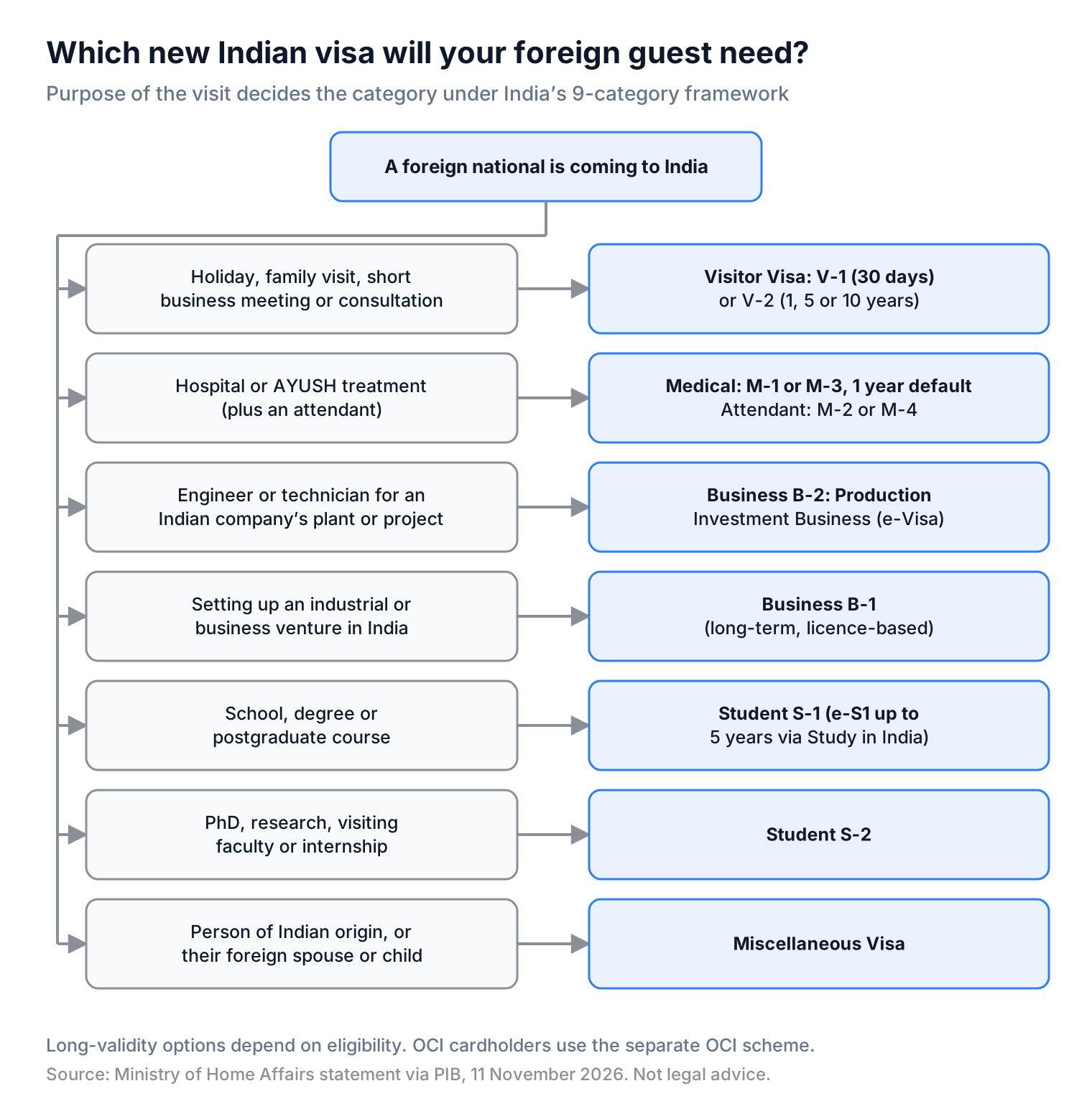
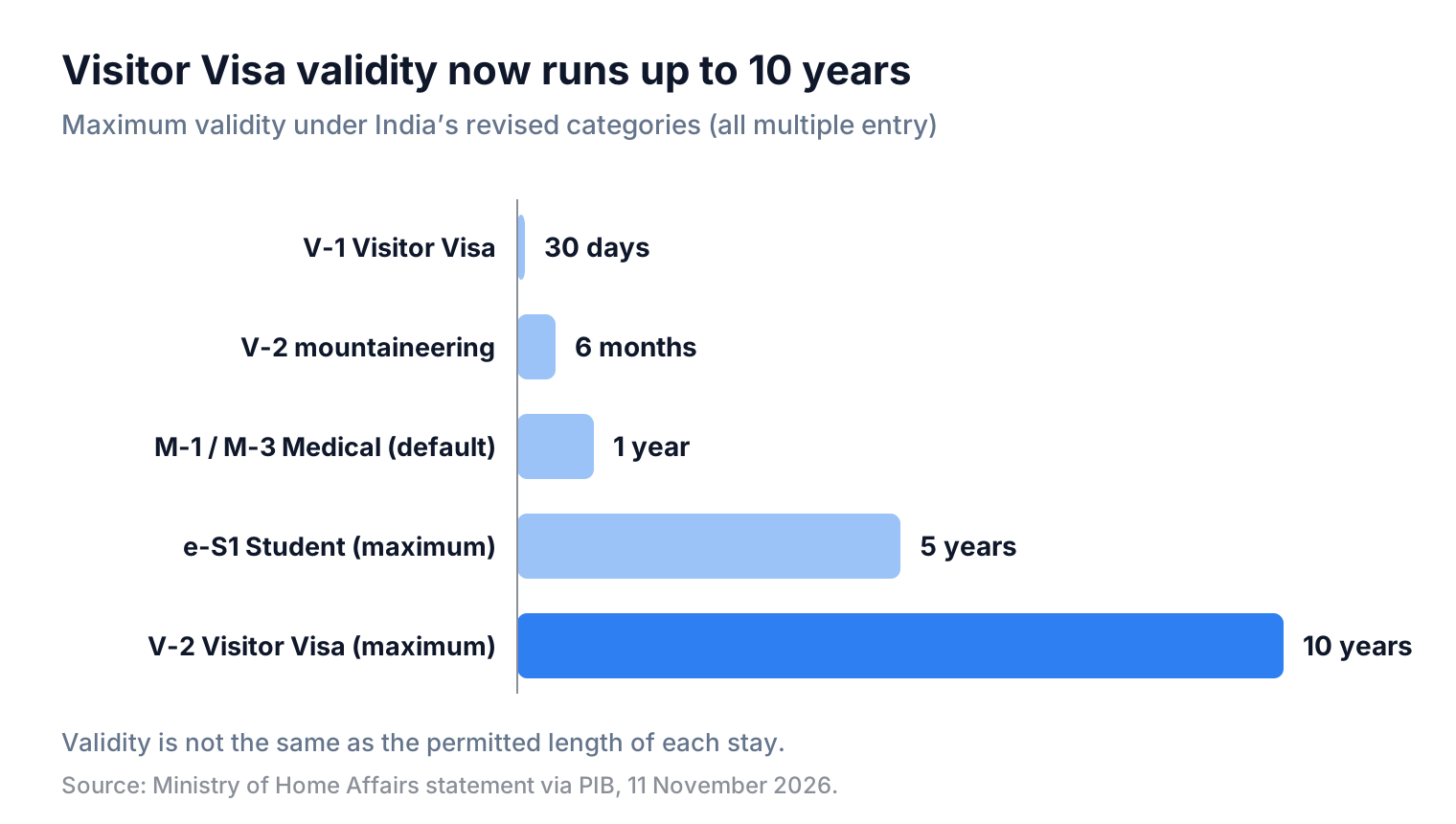
What changed: the Tourist Visa is now called the Visitor Visa because it allows more than sightseeing. The V-1 visa is granted for 30 days with multiple entries and covers tourism plus short activities such as business meetings, medical consultations, wellness retreats, short medical treatment, short yoga programmes and short courses in Indian languages, music, art and craft. The V-2 visa is for longer visits, with validity of 1, 5 or 10 years as specified. It covers everything in V-1 plus mountaineering, which gets a six-month multiple-entry visa.
What Indian hosts should do: if a foreign relative or friend visits often, ask them to watch for the V-2 option once it appears on the official portal. Keep in mind that validity is not the same as how long someone may stay on each visit, and the Ministry has not yet set out every stay condition for V-2.
Medical, student and business visas
Medical visas: one year by default
What changed: India keeps separate routes for conventional treatment (M-1) and AYUSH treatment (M-3). Both, including their e-Visa versions, will be granted for one year with multiple entries as the default. Attendants get the matching M-2 or M-4 visa. The Ministry says this should cut repeat applications when treatment needs several consultations or staged procedures.
What to do: hospitals and families arranging treatment for a foreign patient can plan follow-up visits within a single visa, and should apply for the attendant visa at the same time.
Student visas: S-1 and S-2
What changed: S-1 covers school, graduate and postgraduate study. S-2 covers PhD and research scholars, visiting faculty, research visits, scientific and anthropological expeditions, internships and exchange students. Students admitted through the Study in India portal can get a multiple-entry e-S1 visa for up to five years or the length of the course, whichever is shorter.
Business visas: B-1 and B-2
What changed: B-1 is for long-term, licence-based activity, such as a foreign national setting up an industrial or business venture. B-2 is for short-term, contract-based work, including production investment business, conferences, sports, performing arts and films. Foreign specialists and engineers engaged by Indian companies for installation, commissioning, quality checks, maintenance, IT and ERP ramp-up, training, plant bring-up or technology transfer can get a Production Investment Business Visa under B-2 through the e-Visa platform, which replaces the old e-B4 name.
What Indian companies should do: update invitation letters and internal travel guides to the new B-1 and B-2 names once the portal switches, and route plant and project specialists to the B-2 e-Visa.
Families with foreign spouses or children
What changed: a new Miscellaneous Visa collects purposes that do not fit elsewhere. It covers persons of Indian origin and their spouses and children, people joining specified institutions such as the Auroville Foundation, dependants of foreigners on long-duration visas, stay visas for Afghan nationals, long-term visas for certain nationals of neighbouring countries, and other purposes not covered by another category.
What to do: if your spouse or child holds a foreign passport and is not an OCI cardholder, check which category they fall under once the new forms are live. OCI is a separate scheme and was not part of this announcement.
Does anything change for Indians travelling abroad?
No. This reform covers foreigners coming into India. If you hold an Indian passport, your visa for the US, UK, Schengen, the UAE, Thailand or anywhere else is still decided by that country’s own rules, fees and timelines. Recent changes for outbound travellers, such as Nepal and Bhutan transit rules and South Africa’s ETA, are covered in our earlier updates.
What to do now
- Inviting a foreign guest before year-end? They should apply under the current categories; do not wait for the new system.
- Hosting a patient, student or engineer from abroad? Note the new category name (M, S or B-2) for your invitation letters.
- Family member of Indian origin abroad? Check whether OCI or the Miscellaneous Visa suits them once the portal updates.
- Confirm on official sites. Use the Ministry of Home Affairs and the official Indian visa portal, not forwarded messages.
Apply with Krosz
Planning your own trip abroad, or a visit to relatives overseas? A trained Krosz visa expert prepares each application one-to-one, checks your forms and documents against current requirements, and flags problems before anything is submitted. Decisions always rest with the destination country’s authorities.
The Krosz service fee is a flat ₹1,999 + 18% GST, with government fees shown separately at checkout.
Planning your next trip abroad? Check the visa rules and start your application in minutes. Check your visa →
Sources
- PIB, Ministry of Home Affairs: Government of India rationalizes Indian visa regime (11 Nov 2026)
- Siasat (PTI): India renames tourist visa to visitor visa, simplifies norms (12 Nov 2026)
- Business Standard: India cuts visa categories to 9, trims application fields by up to 70% (12 Nov 2026)
- The Logical Indian: India cuts visa categories from 13 to 9 (12 Nov 2026)
- VisasNews: India Tourist Visa to become Visitor Visa with two new categories (12 Nov 2026)
- Gulf News: India’s new visa rules, Tourist visa replaced, 70% less paperwork (11 Nov 2026)
*This article reflects information published up to 13 November 2026 and is general information, not legal or immigration advice. Always confirm requirements with the Ministry of Home Affairs, the official Indian visa portal or a qualified adviser before you act.*
Frequently asked questions
Has India scrapped the Tourist Visa?
It has been renamed the Visitor Visa and widened. The V-1 Visitor Visa is granted for 30 days with multiple entries and also covers short business meetings, medical consultations, wellness retreats and short courses. The V-2 Visitor Visa is for longer visits, with validity of 1, 5 or 10 years as specified, and also covers mountaineering.
When do the new Indian visa categories start?
The Ministry of Home Affairs says it is updating its IT systems and that visas will be granted under the new framework by the end of 2026. No exact launch date has been announced, so foreign visitors should keep applying under the current categories until the official portal changes.
Does this change visas for Indian passport holders travelling abroad?
No. These rules decide how foreign nationals get a visa to enter India. Visas for Indians going abroad are set by each destination country and are not affected by this announcement.
My foreign spouse is of Indian origin. Which visa will apply?
Under the new framework, persons of Indian origin and their spouses and children fall under the Miscellaneous Visa category. Overseas Citizen of India (OCI) cardholders use the separate OCI scheme. Check the exact eligibility on the official Indian visa portal once the new categories go live.
How long will an Indian medical visa now last?
The M-1 visa (conventional treatment) and M-3 visa (AYUSH treatment), including their e-Visa versions, will be granted for one year with multiple entries as the default. Attendants can get the matching M-2 or M-4 visa.
Our company needs foreign engineers for a plant in India. What changes?
Foreign specialists, engineers and technical staff engaged by Indian companies for work such as installation, commissioning, maintenance, production ramp-up, training or technology transfer can get a Production Investment Business Visa under the B-2 category through the e-Visa platform. This replaces the earlier e-B4 name. Long-term, licence-based activities such as setting up a venture fall under B-1.
How much shorter will Indian visa forms be?
The Home Ministry says the required fields across all 23 categories and sub-categories have been reduced by 65% to 70%, while keeping the details needed for processing. Fewer fields do not mean eligibility checks are relaxed.
All visa destinations · Free visa tools · Pricing · Contact Krosz