Passport Now Needed for Nepal and Bhutan Transit; South Africa Expands ETA for Indians (November 2026)
India’s Immigration and Foreigners (Exemption) (Amendment) Order, 2026 explained for Indian travellers: when you still need no passport for Nepal and Bhutan, when a passport and designated immigration post become mandatory, and how the Kathmandu TCNOC rule fits in. Plus South Africa’s expanded Electronic Travel Authorization for Indians: minors, multi-applicant submissions and the 1 December 2026 eVisa shutdown.
Krosz Visa Desk · Updated 2026-11-08 · 8 min read
Two changes this week affect how Indians plan trips abroad. On 5 November 2026, India’s Home Ministry brought into force an amendment that draws a firm line between direct trips to Nepal or Bhutan, which still need no passport, and third-country journeys routed through them, which now clearly do. A day later, South Africa said its Electronic Travel Authorization (ETA) can now handle children and group applications, and that the old eVisa will be switched off on 1 December 2026. Here is what changed and what to do.
*Information checked on 7 November 2026.*
The quick take
- Direct Nepal or Bhutan trips: still passport-free for Indians with a recognised ID, such as an original voter ID for flights to Nepal.
- Third-country routes via Nepal or Bhutan: a valid passport is now required, and you must use a designated immigration post, effective 5 November 2026.
- Aadhaar and PAN are not travel documents for India–Nepal flights.
- Flying out of Nepal to another country? Check the Indian Embassy Kathmandu TCNOC rule as well.
- South Africa ETA: fully online for eligible Indians, now with minors (biometrics from age 7) and multi-applicant submissions.
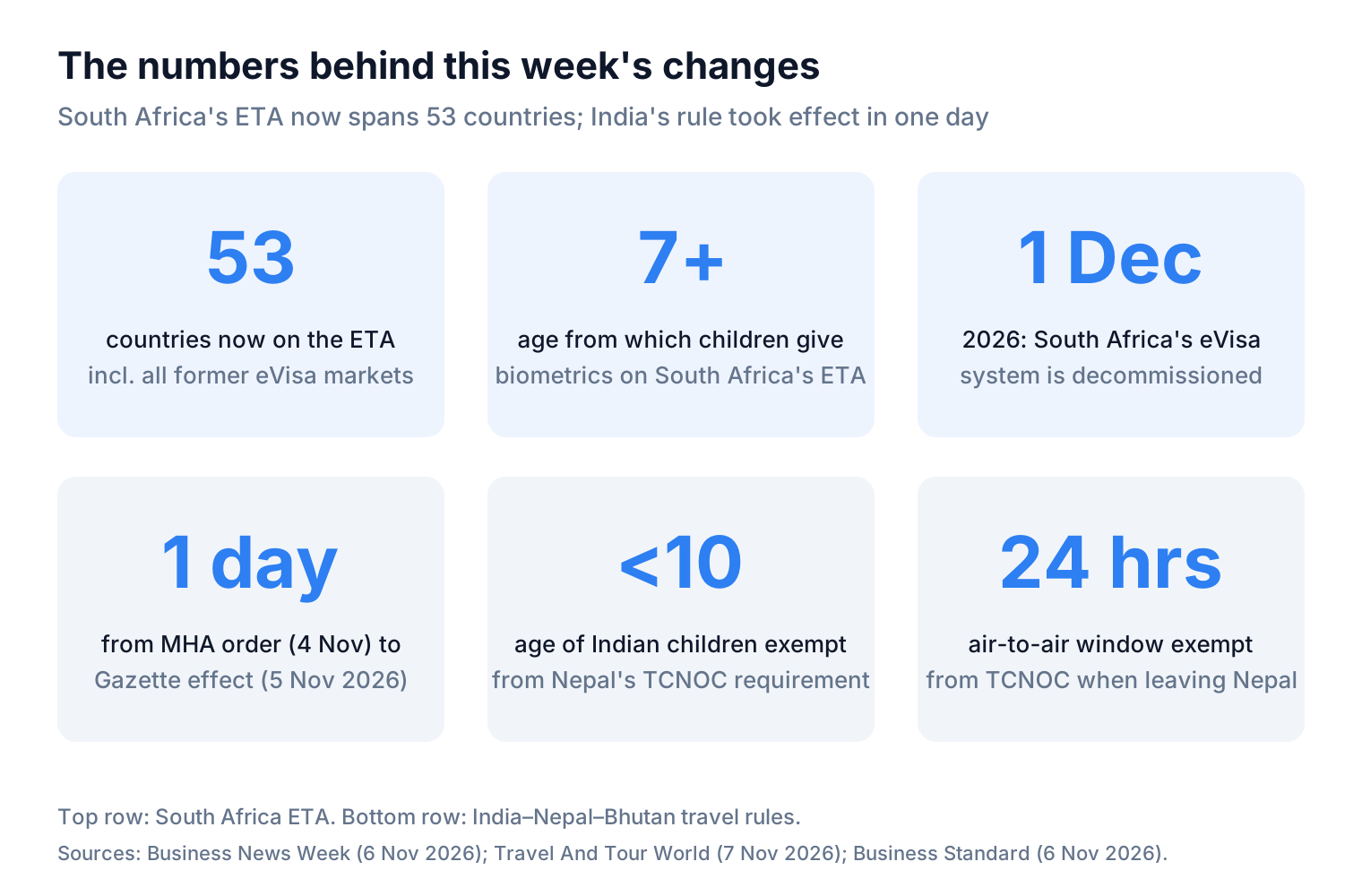
- South Africa eVisa: to be decommissioned on 1 December 2026; the ETA now covers 53 countries.
At a glance
| Change | What it means for Indians | When | Status |
|---|---|---|---|
| India: direct Nepal/Bhutan travel | Passport exemption continues with a Visa Manual-recognised ID | Ongoing | Confirmed in MHA order |
| India: third-country journeys via Nepal/Bhutan | Valid passport plus designated immigration post | From 5 Nov 2026 | In force (Gazette) |
| India: Visa Manual reference | Accepted IDs follow the Visa Manual; officers may ask for more information | From 5 Nov 2026 | In force (Gazette) |
| South Africa: ETA for minors | Children can be included; biometrics for age 7+ | Announced 6 Nov 2026 | Live, per South African Tourism |
| South Africa: multi-applicant ETA | Families and groups submit via one portal | Announced 6 Nov 2026 | Live, per South African Tourism |
| South Africa: eVisa shutdown | All applications move to the ETA | 1 Dec 2026 | Scheduled |
India: passport needed for third-country travel through Nepal or Bhutan
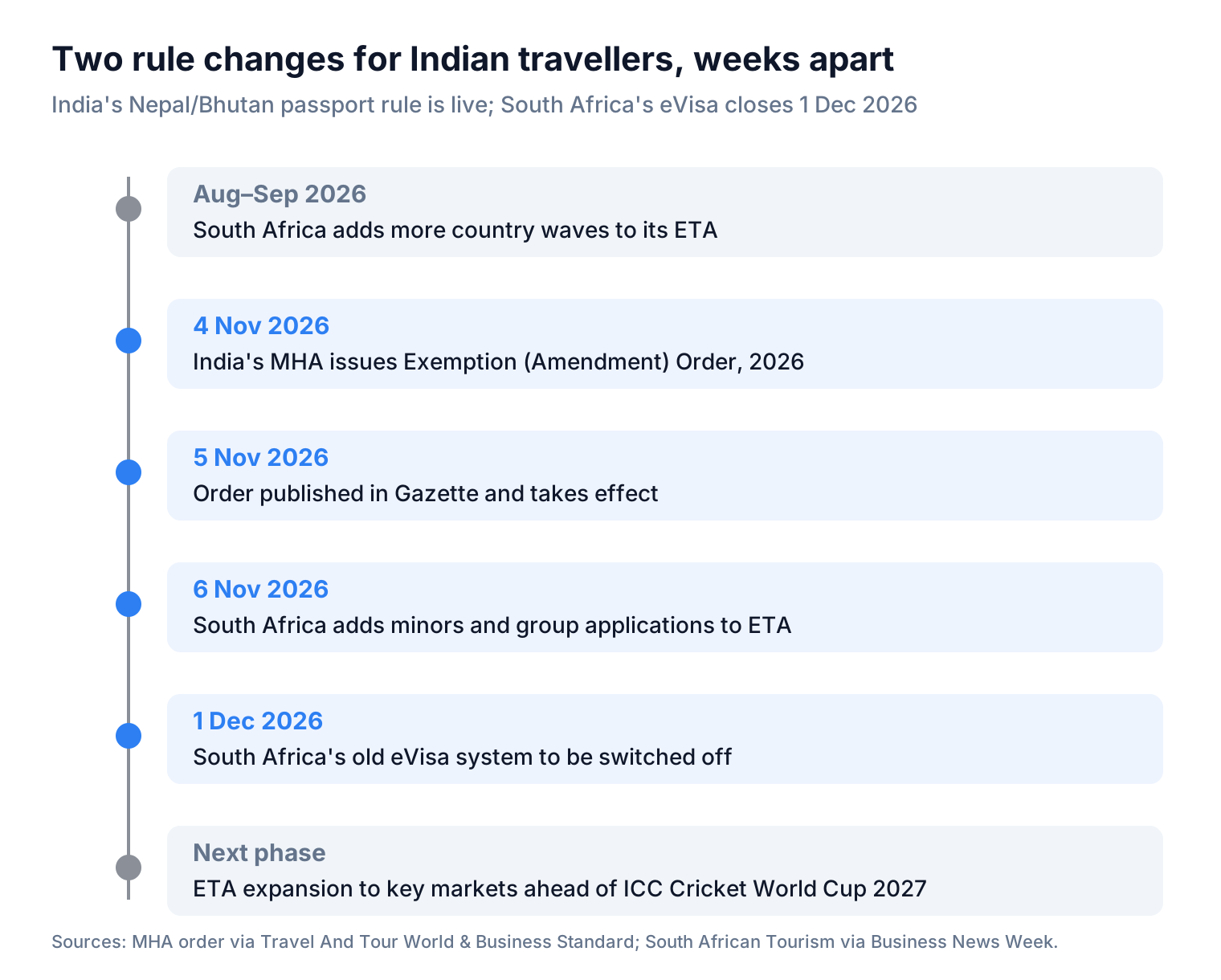
What changed: the Ministry of Home Affairs issued the Immigration and Foreigners (Exemption) (Amendment) Order, 2026 (S.O. 6027(E)) on 4 November 2026. It was published in the Official Gazette and took effect on 5 November 2026. It amends the 2025 exemption order made under the Immigration and Foreigners Act, 2025.
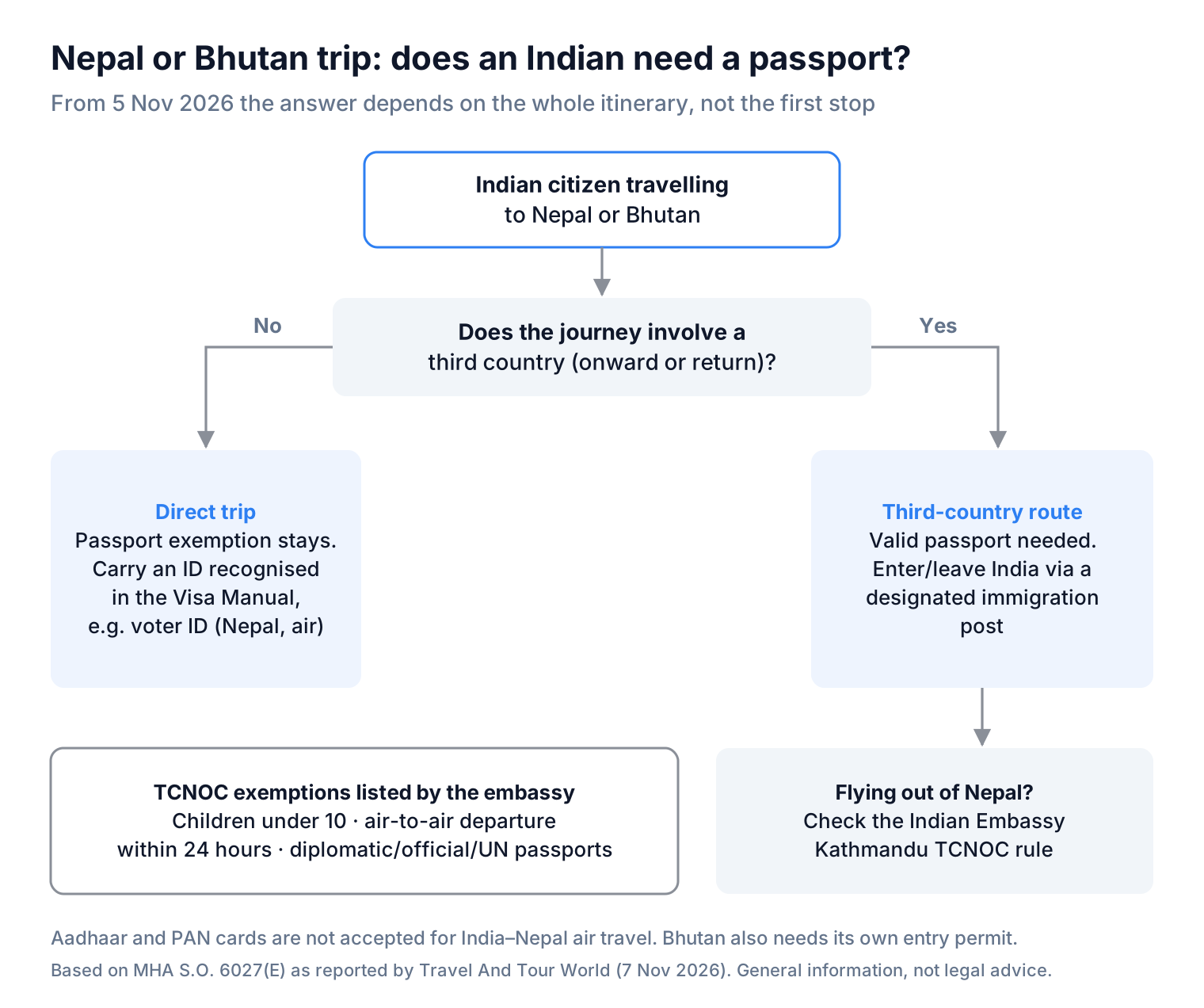
For Indian citizens, the key point is the difference between two kinds of trip. A direct journey between India and Nepal or Bhutan, by land or air, keeps the long-standing passport exemption, provided you carry an identity document recognised in the government’s Visa Manual. But if your journey involves another country, for example flying India to Kathmandu and then on to Dubai, or coming home from abroad via Bhutan, the exemption does not apply. You then need a valid passport and must enter or leave India through a designated immigration post.
The order also adds conditions for Nepalese and Bhutanese citizens, including a passport and visa requirement for those who have embarked at or transited through China, Macau, Hong Kong or Pakistan. Separately, it eases passport and visa rules for certain foreign nationals already living in India.
Which ID works for a direct Nepal or Bhutan trip?
The order does not list every accepted document itself; it points to the Visa Manual. For flights between India and Nepal, the Indian Embassy in Kathmandu recognises a valid Indian passport or an original Election Commission photo voter ID. Aadhaar and PAN cards are not accepted for that purpose. For Bhutan, embassy guidance allows children under 18 without a passport to use an original birth certificate, and Bhutan applies its own entry-permit rules.
The TCNOC: a separate check when leaving Nepal
If you plan to fly from Nepal to a third country, the Indian Embassy in Kathmandu generally requires a Third Country No Objection Certificate (TCNOC). Listed exemptions include children under 10, passengers who leave Nepal by air within 24 hours of arriving by air, and diplomatic, official or UN passport holders. This sits alongside the new order, so a traveller may need both a passport and a TCNOC.
What Indian travellers should do: decide your full itinerary before you book. If Nepal or Bhutan is only a stop on the way to somewhere else, travel on your passport, confirm that your border crossing or airport is an authorised immigration post, and check the TCNOC rule if you are departing Nepal. For a simple direct holiday, carry your passport or original voter ID; do not rely on Aadhaar. Check documents for every child in the family too.
South Africa expands its ETA for Indian travellers
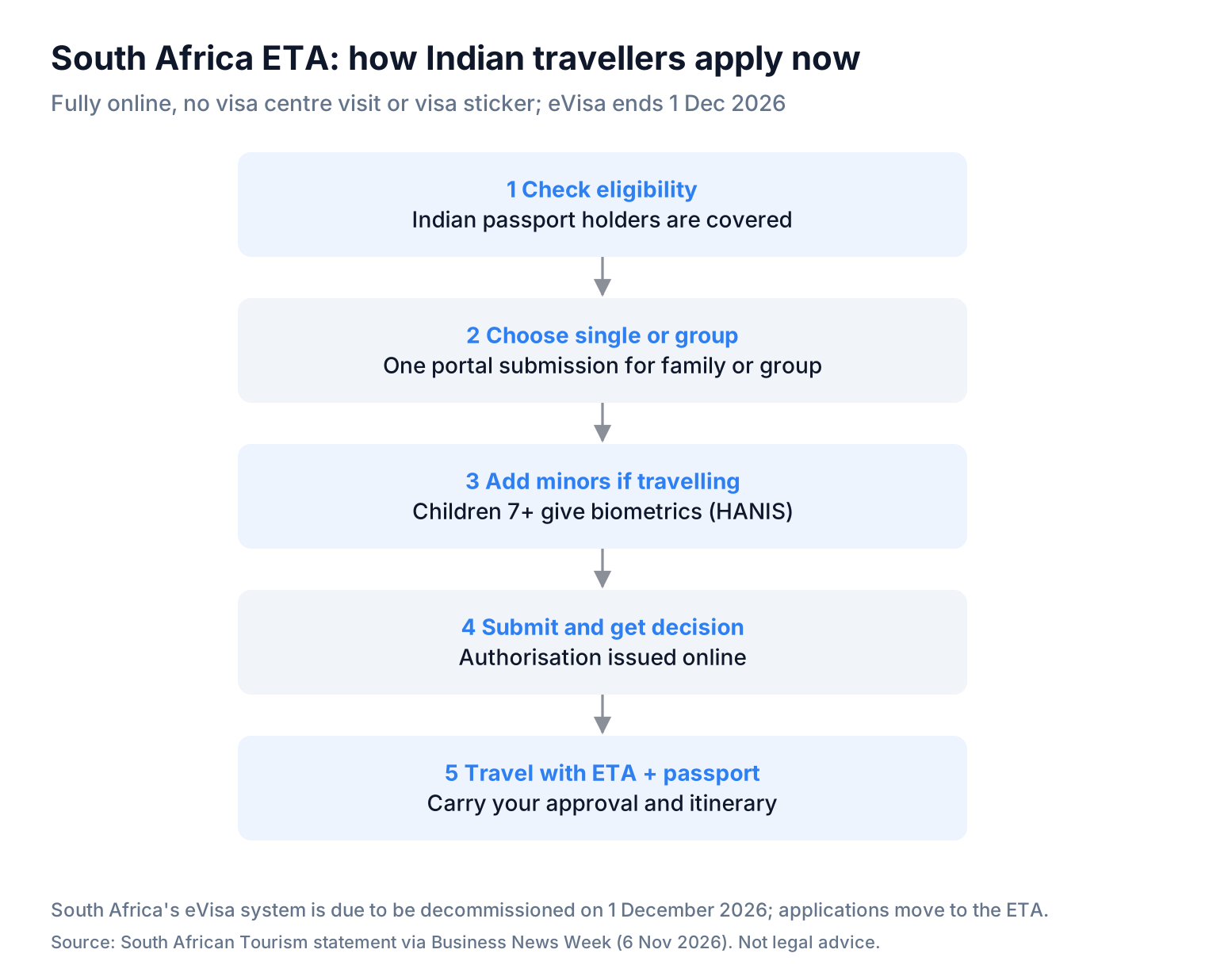
What changed: in a statement dated 6 November 2026, South African Tourism said the Electronic Travel Authorization now supports applications for minors, including biometric capture and enrolment on the Home Affairs National Identification System (HANIS) for children aged seven and above. A new multi-applicant feature lets families and groups submit through a single portal.
Eligible Indian passport holders apply entirely online, with no visa centre visit and no visa sticker. After additional country waves in August and September 2026, the ETA is now available across 53 countries, including every market from the former eVisa programme.
Effective date: the new features are live now. The old eVisa system will be decommissioned on 1 December 2026, after which applications move fully to the ETA. South Africa says the next phase of expansion will target key growth markets ahead of the ICC Cricket World Cup 2027.
What Indian travellers should do: use the ETA route for a South Africa holiday or family trip, and apply for the whole family in one go using the multi-applicant option. Children aged seven and above will need to complete biometrics, so allow time for that step. Requirements such as a valid passport, travel plans and funds still apply, so prepare your documents before you start.
What to do now
- Map the full route. Write down every country you will enter, transit or depart from, not just the first stop.
- Nepal or Bhutan only? Carry a passport or original voter ID; leave Aadhaar and PAN out of the plan.
- Going beyond Nepal or Bhutan? Travel on a valid passport, use a designated immigration post and check the Kathmandu TCNOC rule.
- South Africa trip? Apply through the ETA, add family members together, and plan biometrics for children aged 7+.
- Confirm on official sites. Check the Indian Embassy in Kathmandu or Thimphu, and South Africa’s Department of Home Affairs, before you fly.
Apply with Krosz
Planning South Africa, or a multi-country trip that starts in Nepal? A trained Krosz visa expert handles your application one-to-one, checks your passport, forms and documents against current requirements, and flags route issues before anything is filed. Decisions always rest with the destination country’s authorities.
The Krosz service fee is a flat ₹1,999 + 18% GST, with government fees shown separately at checkout.
Not sure what your itinerary needs? Check your visa requirements and start your application in minutes. Check your visa →
Sources
- Travel And Tour World: India tightens passport checks under revised immigration rules for third-country travel and transit (7 Nov 2026)
- Business Standard: New passport rules for foreigners in India, key exemptions explained (6 Nov 2026)
- Business News Week: South Africa makes travel easier for Indian travellers with expanded Electronic Travel Authorization (6 Nov 2026)
- VisasNews: South Africa says ETA is now fully rolled out
*This article reflects information published up to 7 November 2026 and is general information, not legal or immigration advice. Always confirm requirements with the Indian Embassy in Kathmandu or Thimphu, India’s Bureau of Immigration, or South Africa’s Department of Home Affairs before you travel.*
Frequently asked questions
Do Indians still need a passport to visit Nepal or Bhutan?
Not for a direct trip. Indian citizens travelling directly between India and Nepal or Bhutan keep the passport exemption, as long as they carry an identity document recognised in the government’s Visa Manual. For flights to Nepal, the Indian Embassy in Kathmandu accepts a valid passport or an original Election Commission voter ID card.
What changed on 5 November 2026?
The Home Ministry’s Immigration and Foreigners (Exemption) (Amendment) Order, 2026, issued on 4 November and published in the Gazette on 5 November, makes clear that the exemption does not cover journeys involving another country. If you travel to or from a third country through Nepal or Bhutan, you need a valid passport and must enter or leave India through a designated immigration post.
Can I use my Aadhaar or PAN card to fly to Nepal?
No. According to the Indian Embassy in Kathmandu guidance cited in coverage of the order, Aadhaar and PAN cards do not serve as travel documents for India–Nepal air travel. Carry a passport or an original voter ID card.
What is a TCNOC and do I need one?
A Third Country No Objection Certificate is issued by the Indian Embassy in Kathmandu to Indian nationals flying from Nepal to another country. The embassy lists exemptions, including children under 10, passengers departing by air within 24 hours of arriving by air, and holders of diplomatic, official or UN passports. It is separate from the new passport rule, so you may need both.
Can Indians apply for South Africa’s ETA online?
Yes. South African Tourism says eligible Indian passport holders can apply for the Electronic Travel Authorization fully online, without visiting a visa processing centre or getting a visa sticker.
Can I apply for my children and family on the South Africa ETA?
Yes. The upgraded ETA supports applications for minors, with biometric capture for children aged seven and above, and a multi-applicant feature that lets families and groups submit through one portal.
What happens to South Africa’s eVisa?
South Africa says its eVisa system will be decommissioned on 1 December 2026, with all applications moving to the ETA platform. Markets that were on the eVisa programme have already transitioned to the ETA.
All visa destinations · Free visa tools · Pricing · Contact Krosz