US Court Scraps the Four-Year Student Visa Cap, and Australia’s “No Further Stay” Rule Starts 28 November (November 2026)
What the 16 November 2026 US court judgment vacating the DHS Duration of Status rule means for Indian F-1 students and OPT holders, plus Australia’s mandatory condition 8503 “No Further Stay” on visitor visas from 28 November 2026: who it affects, the lodgement-date rule, waivers and a checklist for Indian parents and tourists.
Krosz Visa Desk · Updated 2026-11-18 · 7 min read
Two decisions this week change the rules for Indians heading to the US and Australia. In the US, a federal court has thrown out the four-year cap on student stays before it ever took effect. In Australia, a new regulation means anyone who applies for a Visitor visa from 28 November 2026 will no longer be able to switch to another visa from inside the country.
Quick take
- US: on 16 November 2026 a federal judge vacated the DHS rule that would have limited F-1 and J-1 stays to four years and foreign journalists to 240 days. Duration of Status (D/S) stays.
- Indian students: India remains the largest source of international students in the US, with 339,435 in 2025–26, down 6%. Graduate and PhD students had the most to lose from a four-year cap.
- Australia: from 28 November 2026, Visitor visas, ETAs and eVisitors applied for on or after that date carry condition 8503 “No Further Stay”.
- Indian parents and tourists: you can still stay for the period granted, but you generally cannot apply for another visa while in Australia. Plan longer stays or a change of visa before you fly.
At a glance
| Change | Country | Date | Who is affected | What to do |
|---|---|---|---|---|
| Four-year student stay rule vacated | United States | Judgment 16 Nov 2026 | F-1 students, J-1 exchange visitors, I-visa journalists and dependants | Keep maintaining status; no new extension filings needed |
| Condition 8503 mandatory on visitor visas | Australia | Applications lodged from 28 Nov 2026 | Visitor visa (600), ETA (601) and eVisitor (651) applicants | Decide your full plan before applying; apply for any other visa from outside Australia |
United States: court vacates the four-year student stay cap
What changed: in July 2026 the Department of Homeland Security published a final rule to replace Duration of Status, the system that lets international students stay as long as they are enrolled and keep their status, with fixed admission periods. F-1 students and J-1 exchange visitors would have been admitted for their programme end date or four years, whichever came first, and foreign journalists on I visas for up to 240 days. Anyone needing more time would have had to apply for an extension.
The rule was due to start on 15 September but was postponed by the court the day before. On 16 November 2026, US District Judge F. Dennis Saylor IV in Massachusetts granted summary judgment to a coalition of universities, educators and unions and set the whole rule aside, finding it arbitrary and capricious under US administrative law. NAFSA, one of the challengers, described it as a final decision on the merits rather than a temporary pause.
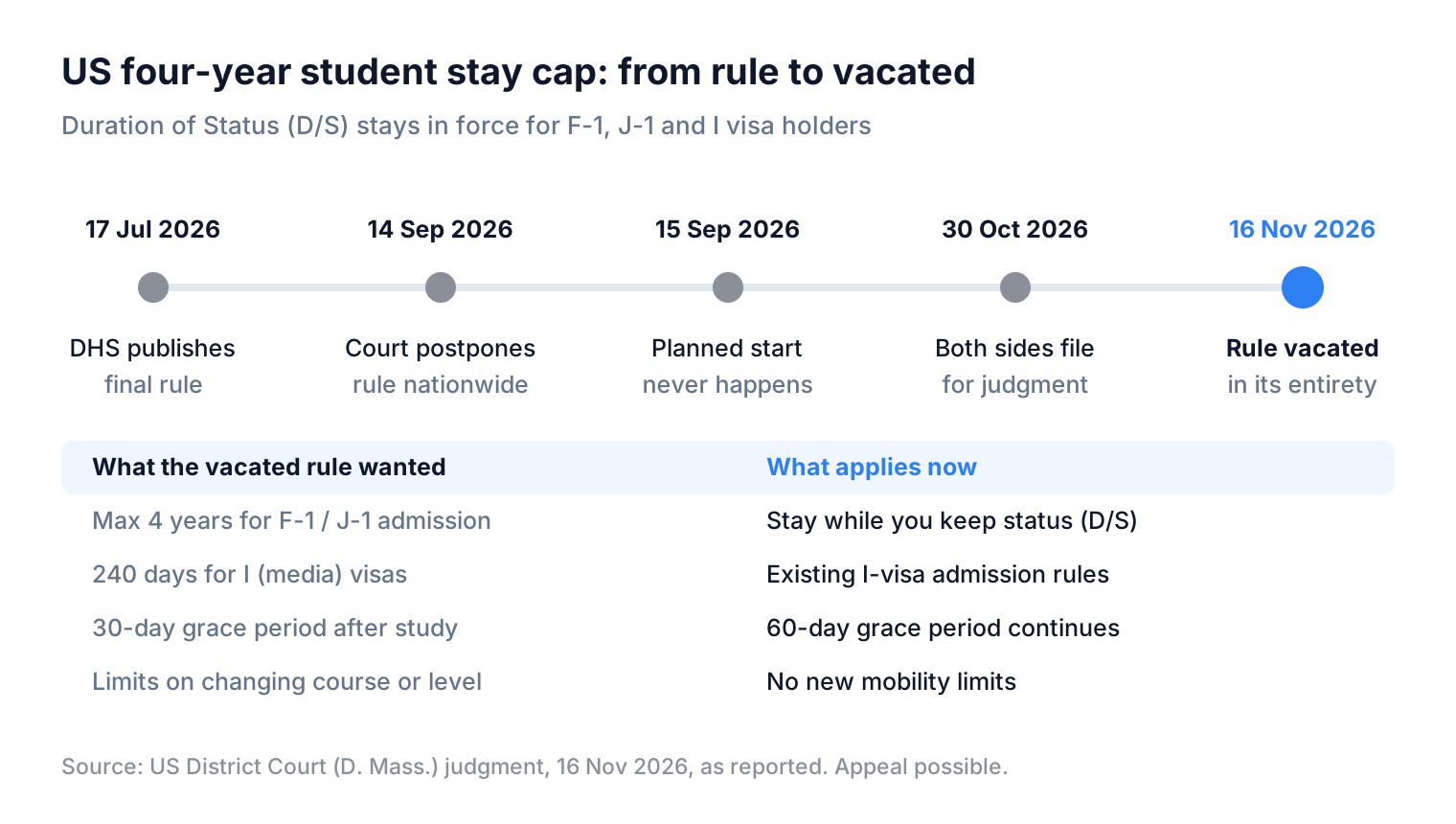
Why it matters for Indians: the court also struck out limits that could have stopped students changing their field of study, transferring, pursuing joint degrees or enrolling in another programme at the same or a lower level. The departure grace period after finishing a programme stays at 60 days; the rule would have cut it to 30.
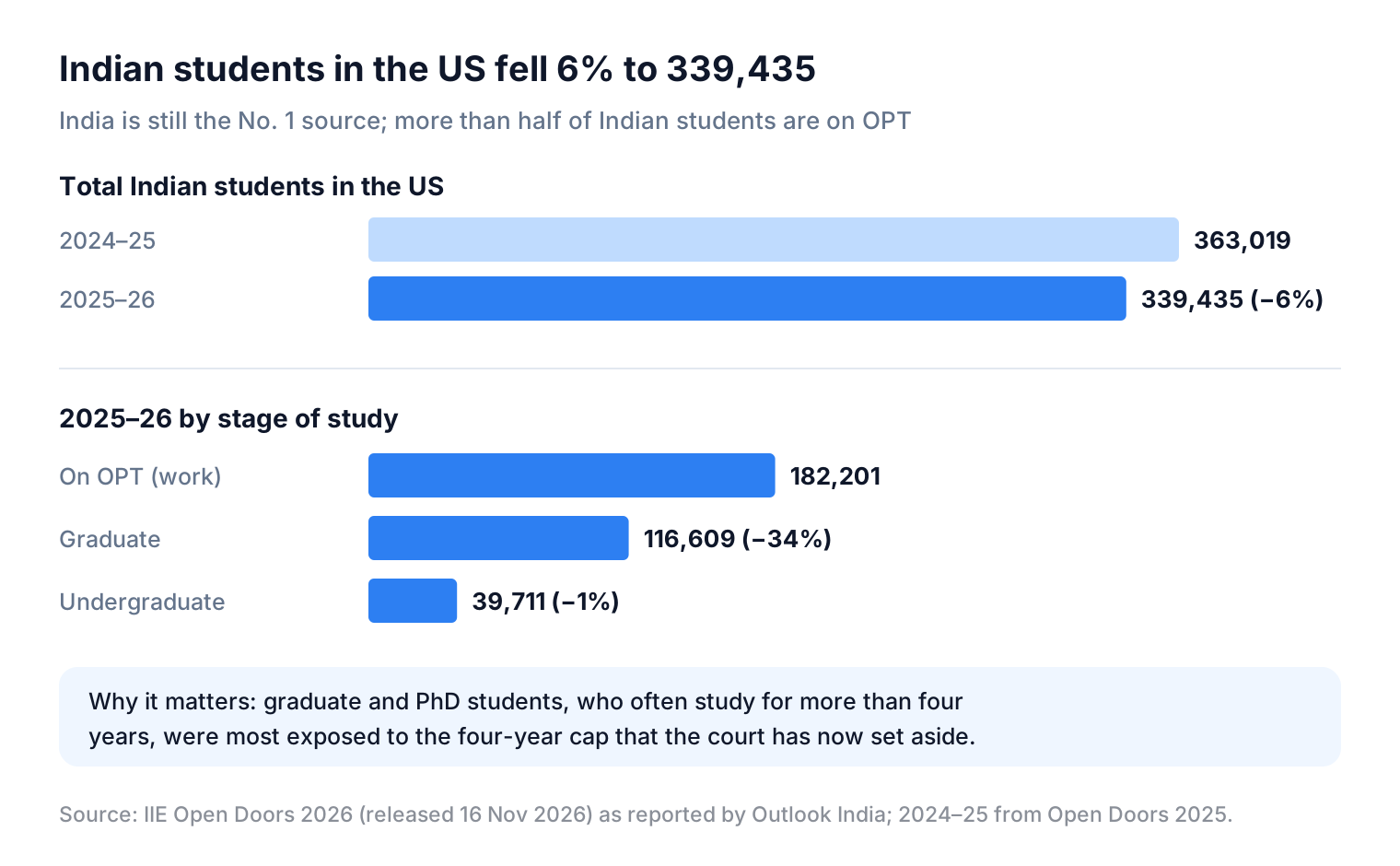
The timing coincides with new enrolment data. According to the Open Doors 2026 report released on 16 November, India was the largest source of international students in the US for the third year running, with 339,435 students in 2025–26, about 29.6% of the total. That was 6% fewer than the year before, and graduate enrolment fell 34%. More than half of Indian students counted, 182,201, were on Optional Practical Training.
What Indian students should do:
- If you are already in the US, keep following the existing rules: stay enrolled full-time, keep your I-20 current and follow OPT or CPT conditions. The ruling does not fix a separate status problem.
- If you are planning a PhD or a degree longer than four years, you will not face the four-year admission clock while the judgment stands.
- If you are applying from India, nothing changes at the consulate. Prepare your F-1 file as before and book your interview early.
- Watch for an appeal. The government can challenge the judgment, and the rules could change if a higher court stays or reverses it.
Australia: “No Further Stay” becomes mandatory on visitor visas from 28 November
What changed: the Migration Amendment (Preventing Further Stay for Visitor Visas) Regulations 2026, signed on 12 November and registered on 13 November, make condition 8503 mandatory for three visitor categories: the Visitor visa (subclass 600), the Electronic Travel Authority (subclass 601) and the eVisitor (subclass 651). Indian passport holders normally apply for the subclass 600 Visitor visa.
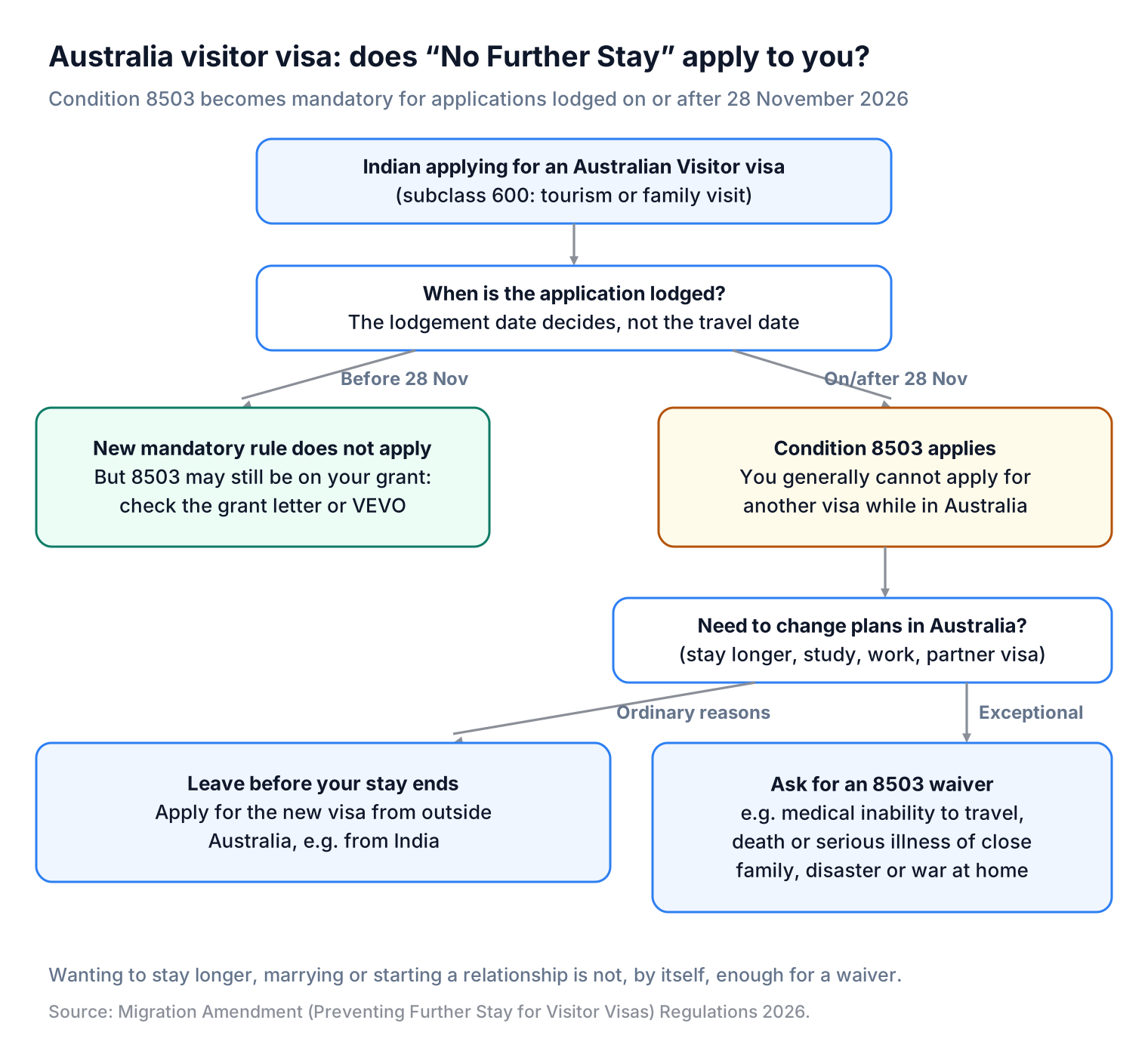
Effective date: the rule covers visa applications lodged on or after 28 November 2026. The date you apply decides it, not the date you travel. Visas already granted are not changed automatically, but case officers could already add 8503 to some Visitor visas before this, so check your grant letter or Australia’s VEVO (Visa Entitlement Verification Online) service.
What 8503 does: it does not shorten your stay. It generally stops you from applying for another visa, temporary or permanent, while you are in Australia. If you arrive as a visitor and later decide to stay longer, study, work or apply for a partner visa, you would need to leave and apply from outside the country. Protection visa applications are an exception.
Who this hits hardest: Indian parents who visit children studying or working in Australia, and travellers who used to extend a trip by applying for a fresh visitor visa onshore. The government says the aim is to stop “visa hopping” between temporary visas after arriving as a visitor. Working Holiday and student visas are not directly covered by this amendment.
Waivers: Home Affairs can waive 8503 only where circumstances changed after the grant and were beyond your control, such as a medical condition that stops you travelling, the death or serious illness of a close family member, or a natural disaster or war at home. Wanting to stay longer, getting married or starting a relationship is not enough on its own, and asking for a waiver does not let you overstay.
What Indian travellers should do:
- Plan the full length of your visit before you apply. Ask for the stay you actually need in the application and back it with matching evidence: return tickets, funds and ties to India.
- Parents visiting students or workers: if a long stay is likely, consider the right visa stream from the start rather than counting on an onshore extension.
- Already holding a visa? Check its conditions on VEVO before you travel.
- Thinking of studying or working later? Apply for that visa from India. Do not enter as a visitor planning to switch.
What to do now
- US students and families: no action needed beyond keeping status. Keep copies of your I-20, enrolment proof and I-94.
- Australia visitors: if your plans fit a single trip, nothing changes in practice. If they might grow, decide now and apply for the right visa before 28 November or from outside Australia later.
- Everyone: rely on official sources and your grant notice, not social-media summaries, before you change travel plans.
Apply with Krosz
Applying for an Australian Visitor visa for your parents, or a US visa for study or travel? A trained Krosz visa expert prepares each application one-to-one, checks your forms and documents against the current rules and flags gaps before anything is submitted. Decisions always rest with the destination country’s authorities.
The Krosz service fee is a flat ₹1,999 + 18% GST, with government fees shown separately at checkout.
Planning your next trip abroad? Check the visa rules and start your application in minutes. Check your visa →
Sources
- Outlook India: Trump’s US visa rule for foreign students, journalists struck down by court (17 Nov 2026)
- Day 1 CPT: Federal court vacates DHS rule to end F-1 Duration of Status (16 Nov 2026)
- Go Elite: Federal court vacates DHS Duration-of-Status rule (16 Nov 2026)
- Immigration Analytics: Duration of Status rule blocked in final ruling by Boston judge (16 Nov 2026)
- VisasNews: Australia to make “No Further Stay” condition mandatory for Visitor Visas starting November 28 (13 Nov 2026)
- Federal Register of Legislation: Migration Amendment (Preventing Further Stay for Visitor Visas) Regulations 2026
- Department of Home Affairs: No Further Stay waiver
- Department of Home Affairs: Check visa details and conditions (VEVO)
*This article reflects information published up to 18 November 2026 and is general information, not legal or immigration advice. The US judgment may be appealed, and visa conditions are set at grant. Confirm requirements with the relevant authorities or a qualified adviser before you act.*
Frequently asked questions
Is the US four-year limit on F-1 student visas still coming?
No, not for now. On 16 November 2026 a federal judge in Massachusetts granted summary judgment to the challengers and vacated the Department of Homeland Security rule in full. Duration of Status, under which students may stay while they keep valid status, remains in place nationwide. The government can still appeal, and the position would change only if the judgment is stayed or reversed.
Does the ruling change anything for Indian students already in the US?
It keeps the current system. You do not need to file the extensions the rule would have required after four years, the 60-day grace period after your programme continues, and the proposed limits on changing your course, transferring or studying at the same level again do not apply. You must still maintain your status, keep your I-20 current and follow OPT or CPT rules.
Does the ruling make it easier to get a US student visa from India?
Not directly. The case was about how long students may stay after they are admitted, not about visa issuance. Interview scheduling, document checks and social-media vetting are unchanged, so prepare your F-1 application exactly as before.
What is Australia’s “No Further Stay” condition 8503?
It is a visa condition that generally stops the holder from applying for most other visas while they are in Australia. From 28 November 2026 it becomes mandatory on Visitor visas (subclass 600), the ETA (subclass 601) and the eVisitor (subclass 651). Indians typically use the subclass 600 Visitor visa.
I applied for an Australian Visitor visa before 28 November. Does 8503 apply to me?
The new mandatory rule applies to applications lodged on or after 28 November 2026, and the lodgement date decides, not your travel date. Your visa may still carry 8503 if the case officer added it at grant, which was already possible before this change, so check your grant letter or Australia’s VEVO service.
Can I still stay up to the period on my Australian Visitor visa?
Yes. The change does not shorten how long you may stay. It stops you from applying from inside Australia for a new visa, such as a longer visitor visa, a student visa or a partner visa. If you want a different visa, leave before your stay ends and apply from outside Australia.
Can condition 8503 be waived?
Only in limited cases. Australia’s Department of Home Affairs considers waivers where circumstances changed after the visa was granted and were beyond your control, for example a medical condition that stops you travelling, the death or serious illness of a close family member, or a disaster or war in your home country. Simply wanting to stay longer, marrying or starting a relationship is not enough on its own.
All visa destinations · Free visa tools · Pricing · Contact Krosz