Canada Visitor Visa From India Now Takes 34 Days, Super Visa 87: What the Latest IRCC Update Means (November 2026)
Canada visa processing times for Indians, November 2026: visitor visa (TRV) 34 days, super visa 87 days, work permit 10 weeks and study permit 8 weeks, compared with IRCC service standards and other countries, plus a step-by-step planning guide for Indian travellers.
Krosz Visa Desk · Updated 2026-11-15 · 6 min read
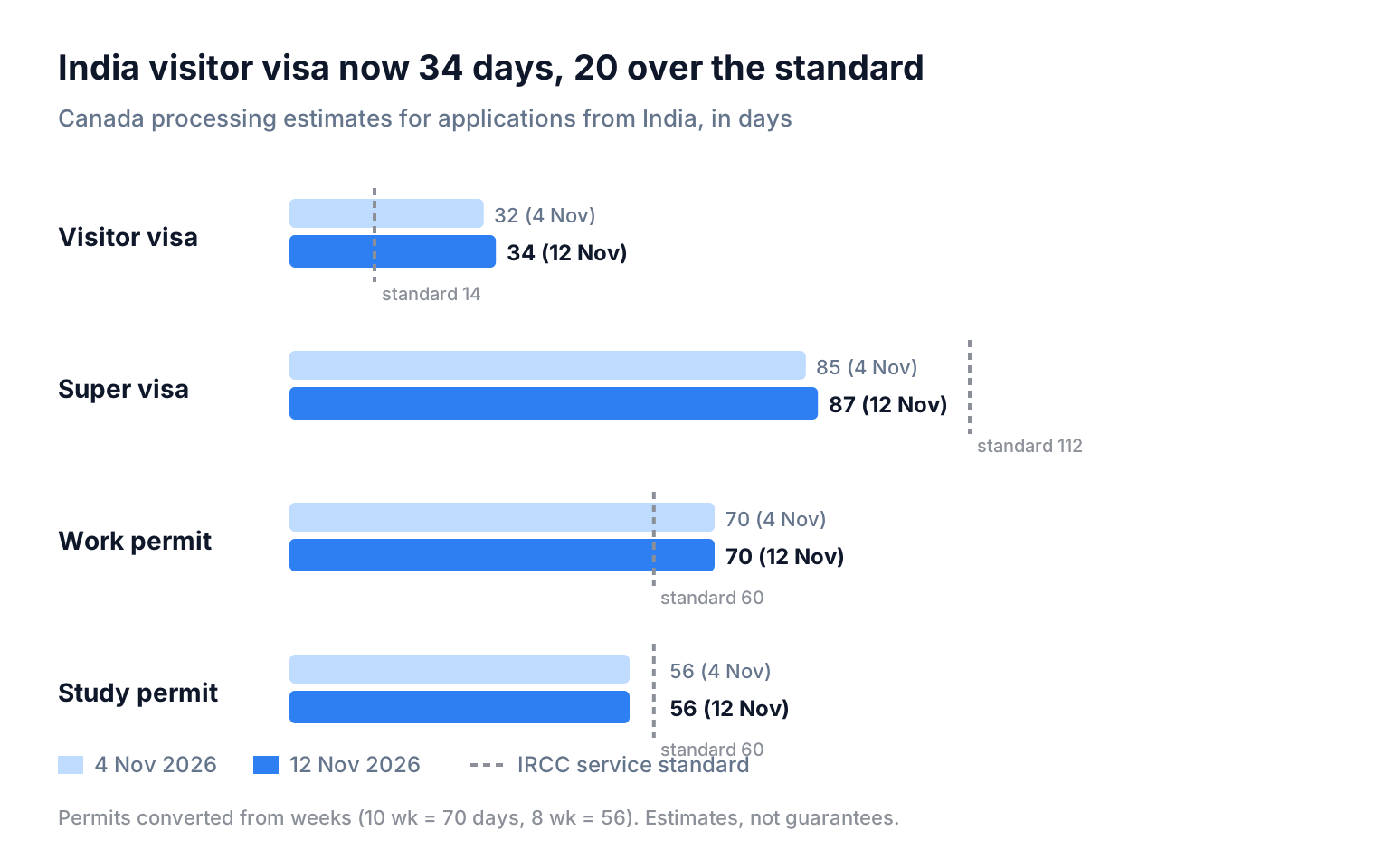
Canada has nudged its waiting times up again for Indian travellers. In the processing-time figures dated 12 November 2026, Immigration, Refugees and Citizenship Canada (IRCC) estimates 34 days for a visitor visa applied for from India, two days more than on 4 November, and 87 days for a super visa for parents and grandparents. Study and work permit estimates for India held steady. If you are planning a Christmas, New Year or spring trip to Canada, these numbers decide when you need to apply.
*Information checked on 15 November 2026.*
The quick take
- Visitor visa from India: about 34 days (was 32), against IRCC’s 14-day service standard.
- Super visa for parents/grandparents in India: about 87 days (was 85), still under the 112-day standard.
- Study permit: unchanged at about 8 weeks. Work permit: unchanged at about 10 weeks.
- Biometrics are included in IRCC’s estimate; passport stamping and courier time are extra.
- Estimates change weekly and are not guarantees, so build in a buffer of several weeks.
At a glance
| Application from India | 4 Nov 2026 | 12 Nov 2026 | IRCC service standard | What to do |
|---|---|---|---|---|
| Visitor visa (TRV) | 32 days | 34 days | 14 days | Apply 8 or more weeks before travel |
| Super visa (parents/grandparents) | 85 days | 87 days | 112 days | Apply about 4 months ahead |
| Work permit | 10 weeks | 10 weeks | 60 days | Line up the start date with your employer |
| Study permit | 8 weeks | 8 weeks | 60 days | Apply as soon as you have your acceptance letter |
Visitor visa: 34 days, and why that matters
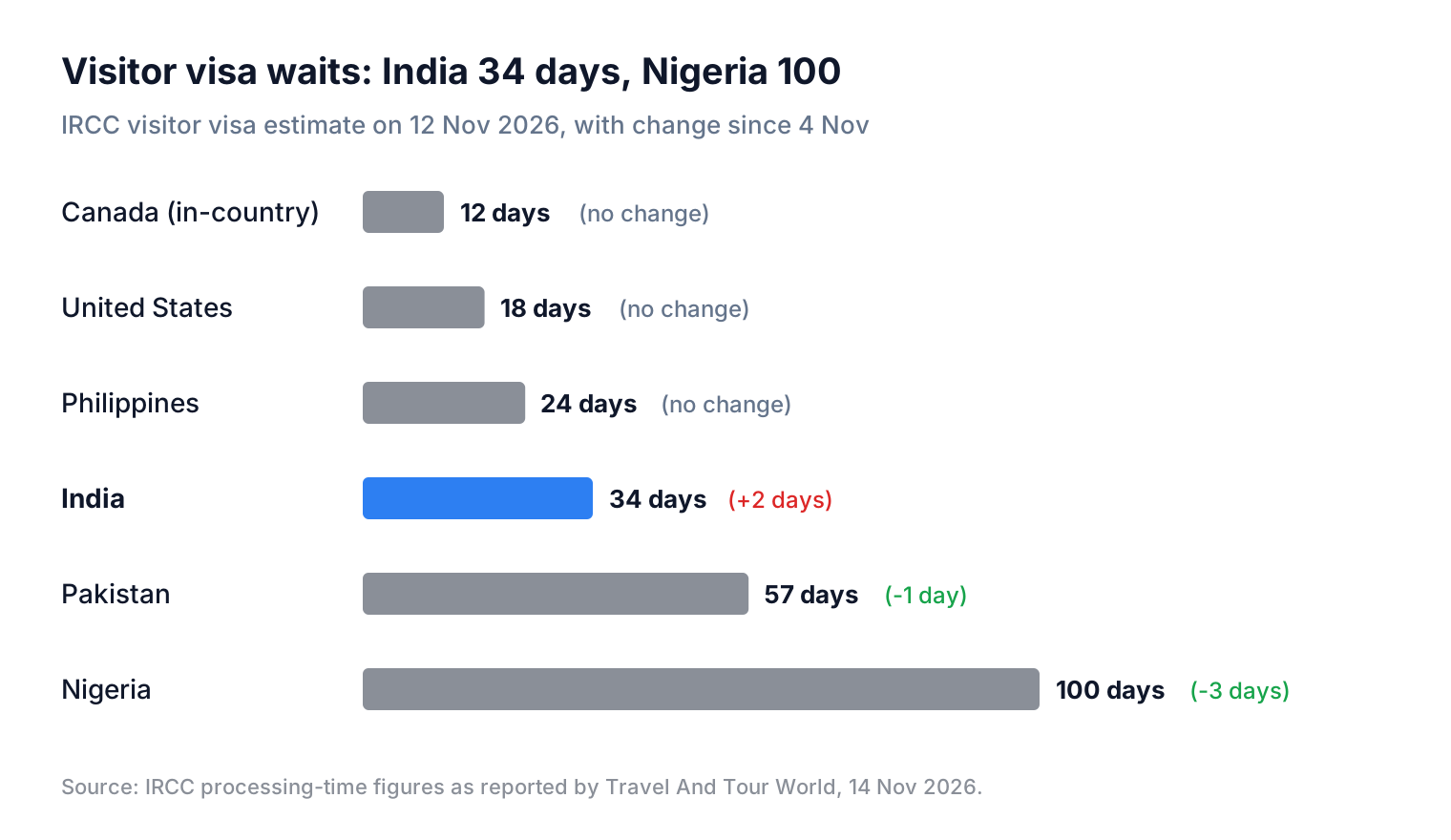
What changed: the estimate for a Canada visitor visa, also called a temporary resident visa (TRV), rose from 32 to 34 days for applications made from India between the 4 and 12 November updates. IRCC’s own service standard for new visitor visa applications from outside Canada is 14 days, so India now sits 20 days above that target.
How India compares: applications from the United States were estimated at 18 days and from the Philippines at 24, both unchanged. Pakistan improved by a day to 57, and Nigeria by three days to 100. Applications made from inside Canada stood at 12 days. In other words, India is in the middle of the pack, but the trend for Indian applicants is edging the wrong way.
What Indian travellers should do: treat 34 days as the minimum, not the plan. IRCC’s estimate already includes giving biometrics, but you still need to send your passport when asked and get it back through the visa application centre. For a holiday or family visit, apply at least 8 weeks before you fly, and earlier if your dates are fixed or you are booking non-refundable tickets.
Super visa: 87 days for parents and grandparents
What changed: for parents or grandparents living in India, the super visa estimate rose from 85 to 87 days. Unlike the visitor visa, this is still within IRCC’s 112-day service standard for super visa applications made from outside Canada. The super visa lets parents and grandparents of Canadian citizens and permanent residents make longer visits than an ordinary visitor visa allows.
What to do: if your parents want to be in Canada for a birth, a graduation or a summer visit, start roughly four months before the target date. Gather the sponsor’s invitation and supporting documents, and the medical insurance a super visa requires, before you file, because IRCC treats files needing extra documents as non-routine, which takes longer.
Study and work permits: no change for India
What the update shows: study permit applications from India stayed at about 8 weeks and work permit applications at about 10 weeks. Elsewhere, Pakistan’s study permit estimate fell to 4 weeks and applications from within Canada to 6 weeks, while Pakistan and the Philippines saw work permit estimates rise by a week to 10. IRCC’s service standard for both new study and new work permits from outside Canada is 60 days.
What to do: students heading for a January or May intake should file as soon as they have an acceptance letter and their funds are documented. Workers should agree a realistic start date with their employer that allows for the 10-week estimate plus travel.
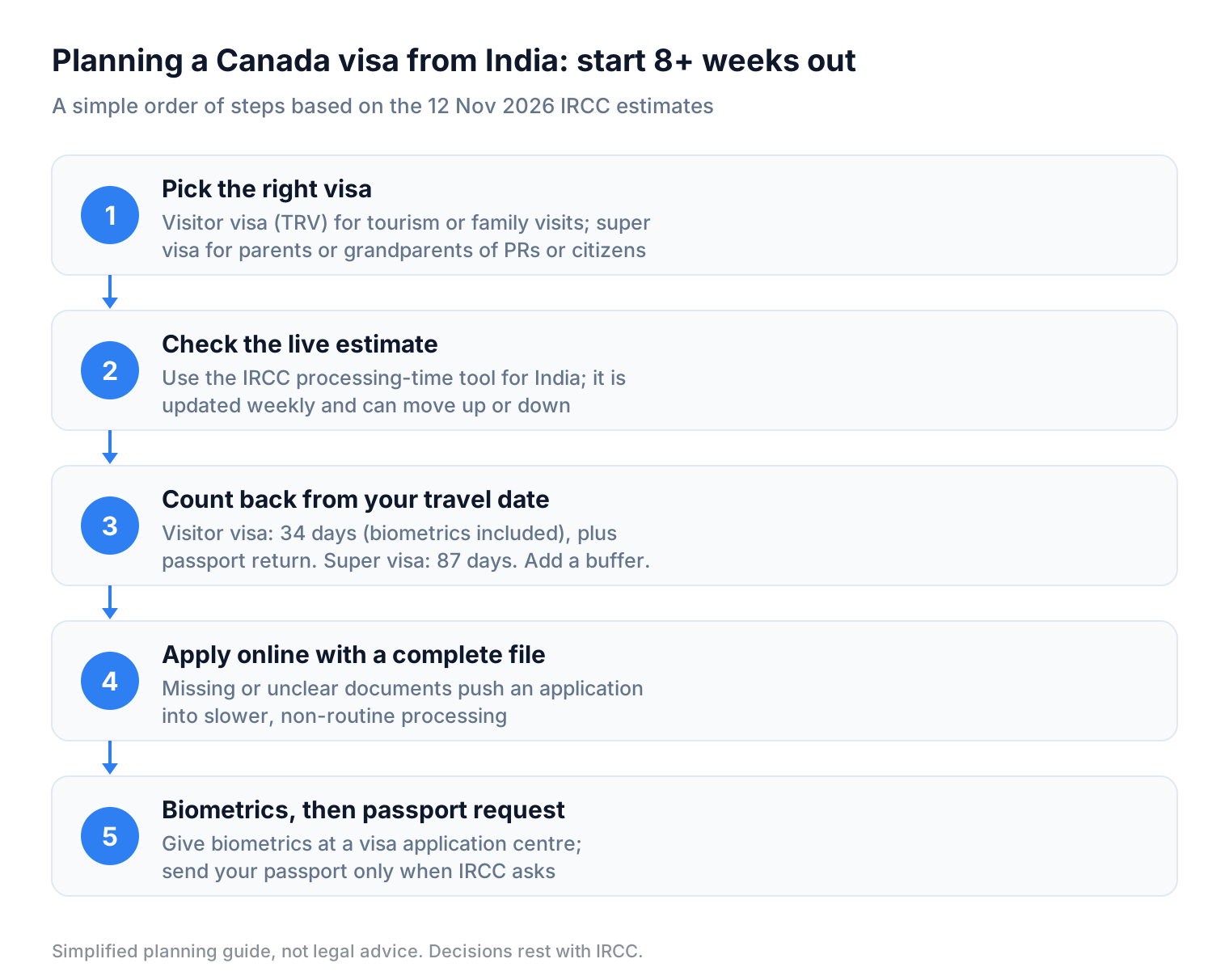
How to plan your Canada application from India
- Pick the right visa. A visitor visa covers tourism and family visits; a super visa is for parents and grandparents of Canadian citizens or permanent residents who want longer stays.
- Check the live estimate. Use the IRCC processing-time tool and choose India as the country you apply from; the figure changes regularly.
- Count back from your travel date. Add the estimate, passport stamping and return, and a buffer of a few weeks.
- Apply online with a complete file. IRCC says incomplete applications, unclear document copies and extra verification push files into slower, non-routine processing.
- Give biometrics promptly, then send your passport only when asked. Track the passport through the visa application centre once IRCC requests it.
Why the queue moves
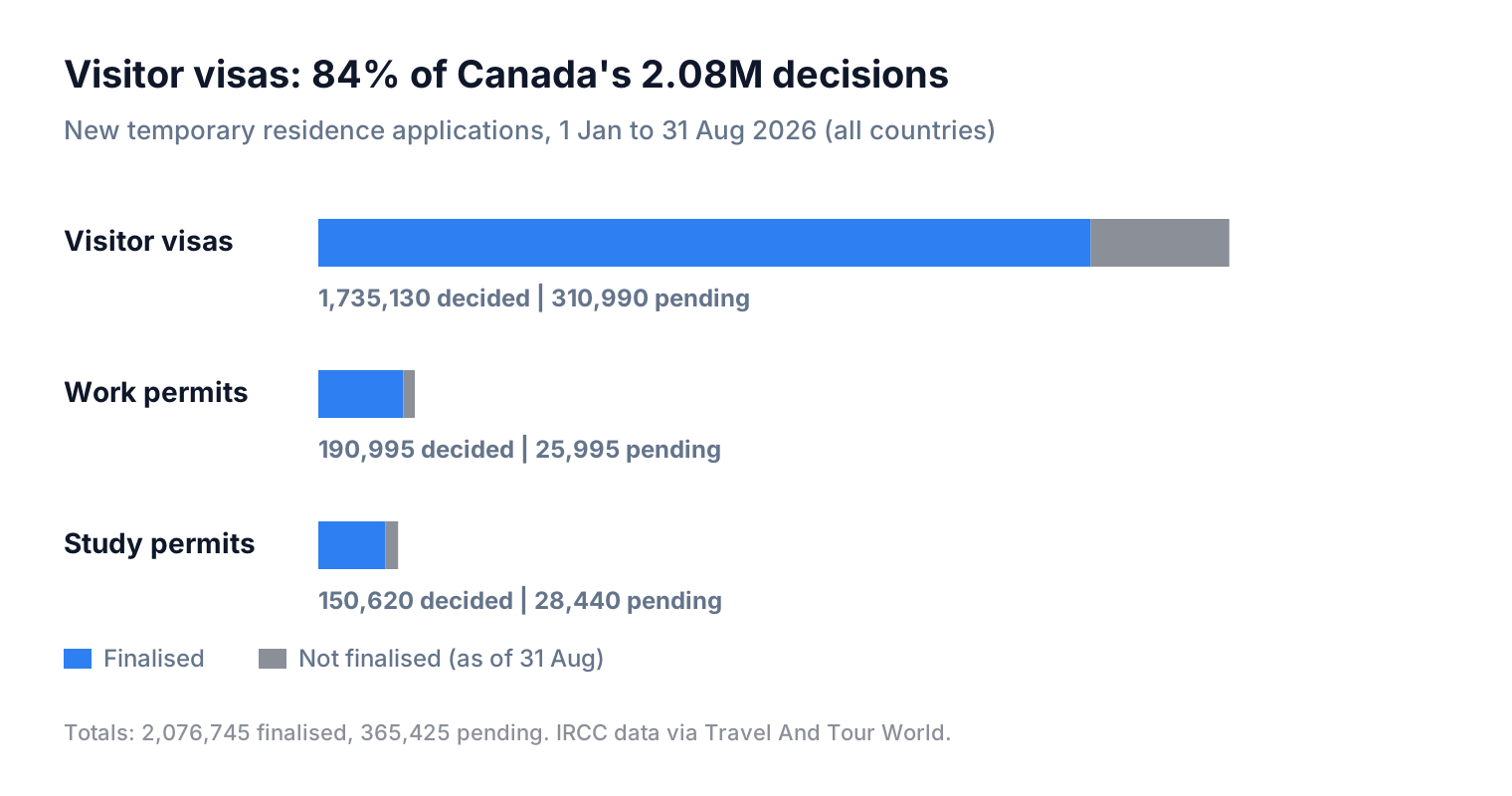
Canada’s visitor visa workload is enormous. Between 1 January and 31 August 2026, IRCC finalised 2,076,745 new temporary residence applications from all countries, of which 1,735,130, about 84%, were visitor visas. Another 365,425 applications were still open on 31 August. IRCC’s forward-looking estimates are built from that inventory, the staff available and the volume it expects, so a seasonal rush can lengthen waits within weeks.
What to do now
- Travelling to Canada before mid-January? If you have not applied yet, apply now and keep bookings flexible.
- Planning a spring or summer trip? File 8 to 12 weeks ahead for a visitor visa, or about four months ahead for a super visa.
- Already applied? Watch your IRCC account for biometrics or passport requests and answer them quickly.
- Students and workers: the estimates are stable, but do not leave filing to the last month before your start date.
Apply with Krosz
Planning a visit to Canada? A trained Krosz visa expert prepares each application one-to-one, checks your forms and documents against the current IRCC requirements, and flags gaps before anything is submitted, so your file is as complete as possible when it joins the queue. Decisions always rest with IRCC.
The Krosz service fee is a flat ₹1,999 + 18% GST, with government fees shown separately at checkout.
Planning your next trip abroad? Check the visa rules and start your application in minutes. Check your visa →
Sources
- IRCC: Check current processing times (page updated 13 Nov 2026)
- Travel And Tour World: Canada visa delays rise for Indian travellers as new IRCC figures spark concern (14 Nov 2026)
- NewsBytes: Canada increases Indian visa waits to 34 and 87 days (14 Nov 2026)
- IRCC: Application processing statistics
*This article reflects information published up to 15 November 2026 and is general information, not legal or immigration advice. Processing times are IRCC estimates and change regularly. Always confirm requirements with IRCC or a qualified adviser before you act.*
Frequently asked questions
How long does a Canada visitor visa take from India right now?
IRCC’s figures dated 12 November 2026 put the estimate for visitor visa applications made from India at 34 days, up from 32 days on 4 November. It is an estimate based on IRCC’s current workload, not a guaranteed decision date, and your own application can take longer.
Does the 34 days include biometrics?
Yes. IRCC says its processing times include the time it takes to give biometrics. The clock starts when IRCC receives your complete application and ends when a decision is made. Sending your passport for the visa stamp and getting it back through the visa application centre comes on top.
How long does a super visa take for parents in India?
The estimate for parents or grandparents living in India is 87 days as of 12 November 2026, up from 85. That is still inside IRCC’s 112-day service standard for super visas applied for from outside Canada.
Did study permit or work permit times change for Indians?
No. Applications from India stayed at about 8 weeks for a study permit and about 10 weeks for a work permit between the 4 and 12 November updates.
Why is India’s visitor visa estimate above the 14-day standard?
The 14-day figure is IRCC’s service standard, a target it aims to meet for most complete applications under normal conditions. The published estimate reflects the real backlog, staffing and expected volumes, so it can sit well above the target. For India it is currently 20 days longer.
How often are Canada processing times updated?
IRCC updates these temporary residence estimates regularly, generally weekly. The next update was expected around 18 November 2026, so check the IRCC tool again close to when you apply.
Can paying more or calling IRCC make my visa faster?
IRCC says calling will not speed up an application. What you control is completeness: incomplete files, unclear document copies or extra verification move an application into slower, non-routine processing.
All visa destinations · Free visa tools · Pricing · Contact Krosz