Australia Eyes Student Funds Rule, Austria Opens Working Holidays to Indians, OCI Late Fee Waived (November 2026)
Three November 2026 updates for Indian travellers and families: Australia’s consultation on Genuine Student and financial capacity reforms for student visas (submissions close 23 November 2026), Austria’s Working Holiday Programme for Indians aged 18 to 30, and the one-time waiver of the OCI passport-update late fee until 31 December 2026.
Krosz Visa Desk · Updated 2026-11-09 · 8 min read
Three updates this week matter for young Indians planning to study, travel or work abroad, and for Indian-origin families living overseas. Australia is asking for feedback on tougher money rules for student visas, with a deadline of 23 November 2026. Austria has opened its 12-month Working Holiday visa to Indians aged 18 to 30. And Indian missions have waived the OCI late fee for passport updates filed by 31 December 2026.
*Information checked on 9 November 2026.*
The quick take
- Australia (proposal): students may have to hold funds in an Australian bank account for 1 to 3 months before lodging a student visa. Nothing has changed yet.
- Australia deadline: feedback closes at 12:00 pm AEDT, 23 November 2026.
- Austria (open now): a Working Holiday Visa D of up to 12 months for Indians aged 18 to 30, applied for at the Austrian Embassy in New Delhi.
- Austria requirements: holiday as the main purpose, EUR 30,000+ insurance, starting funds and a return ticket.
- OCI (relief): the late fee for updating a new passport after 90 days is waived for updates filed 1 November to 31 December 2026.
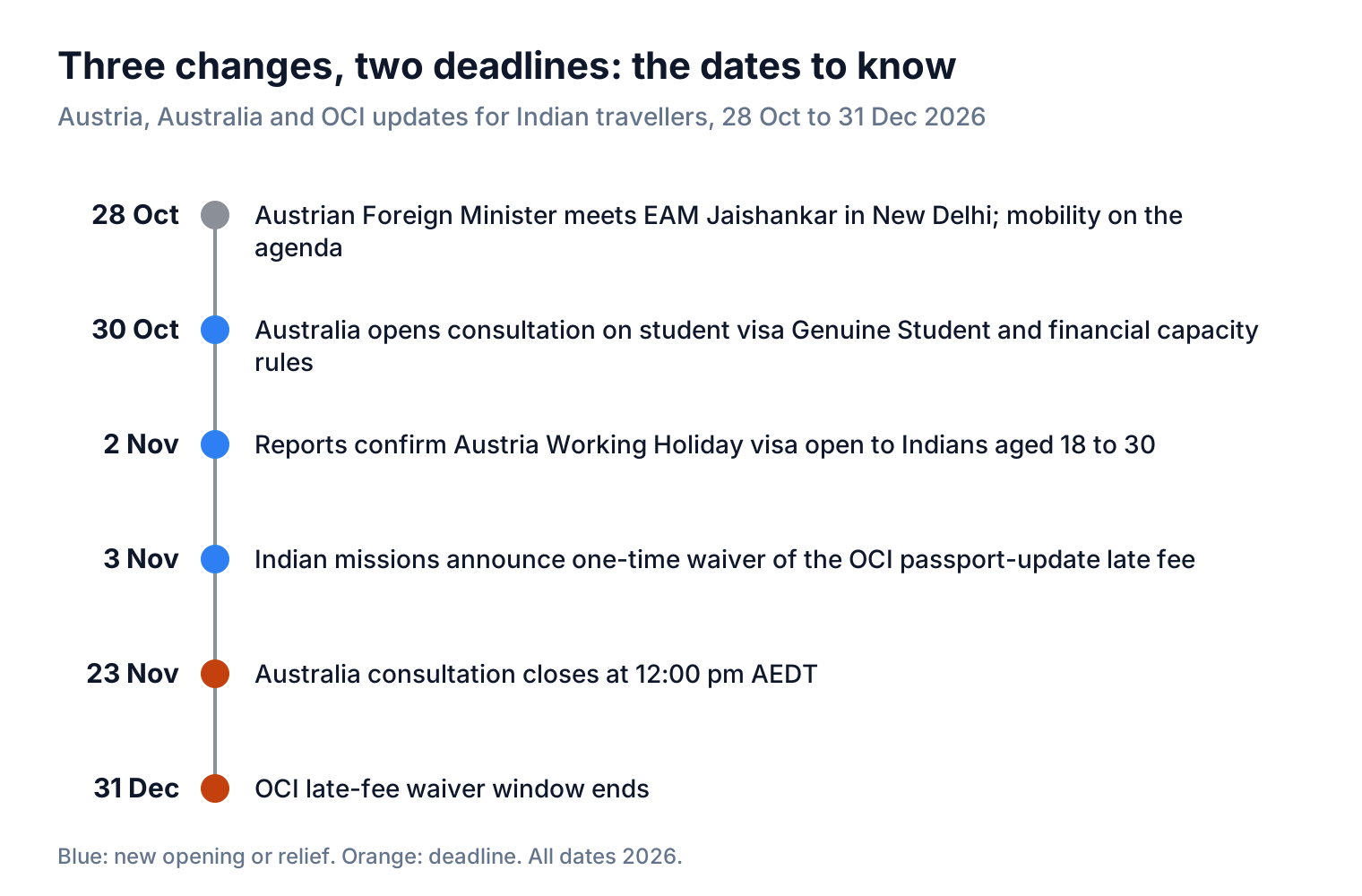
At a glance
| Update | Who it affects | Key date | Status |
|---|---|---|---|
| Australia: Genuine Student and financial capacity reforms | Future student visa applicants, including Indians | Feedback closes 23 Nov 2026 | Proposal; no decision made |
| Austria: Working Holiday Programme | Indian citizens aged 18 to 30 | Open now; apply up to 6 months before travel | Open |
| OCI: passport-update late fee | OCI cardholders with a new foreign passport | Updates filed 1 Nov to 31 Dec 2026 | One-time waiver |
Australia proposes stricter money rules for student visas
What changed: on 30 October 2026, Australia’s Department of Home Affairs opened a consultation on reforms to the Genuine Student (GS) requirement and the financial capacity framework for student visas. Assistant Minister Julian Hill outlined the plan the same day. Home Affairs says no decisions have been made and the feedback will shape advice on whether any reform goes ahead.
The paper puts forward four options for proving you can pay for your studies. Three of them would require the money to sit in an eligible Australian account in your own name before you lodge the visa:
- Managed 50% model: 50% of tuition plus prescribed living costs for the whole course, held for at least one month, then released on a set schedule.
- Flexible 50% model: the same 50% amount, held for at least three months, with no mandatory release schedule.
- First-year assurance: 100% of tuition and living costs for the first 12 months (or the rest of the course if shorter), held for at least three months.
- Recognised education finance: costs met through recognised financial institutions, your own funds or a mix, with a transfer to an Australian account preferred where practical.
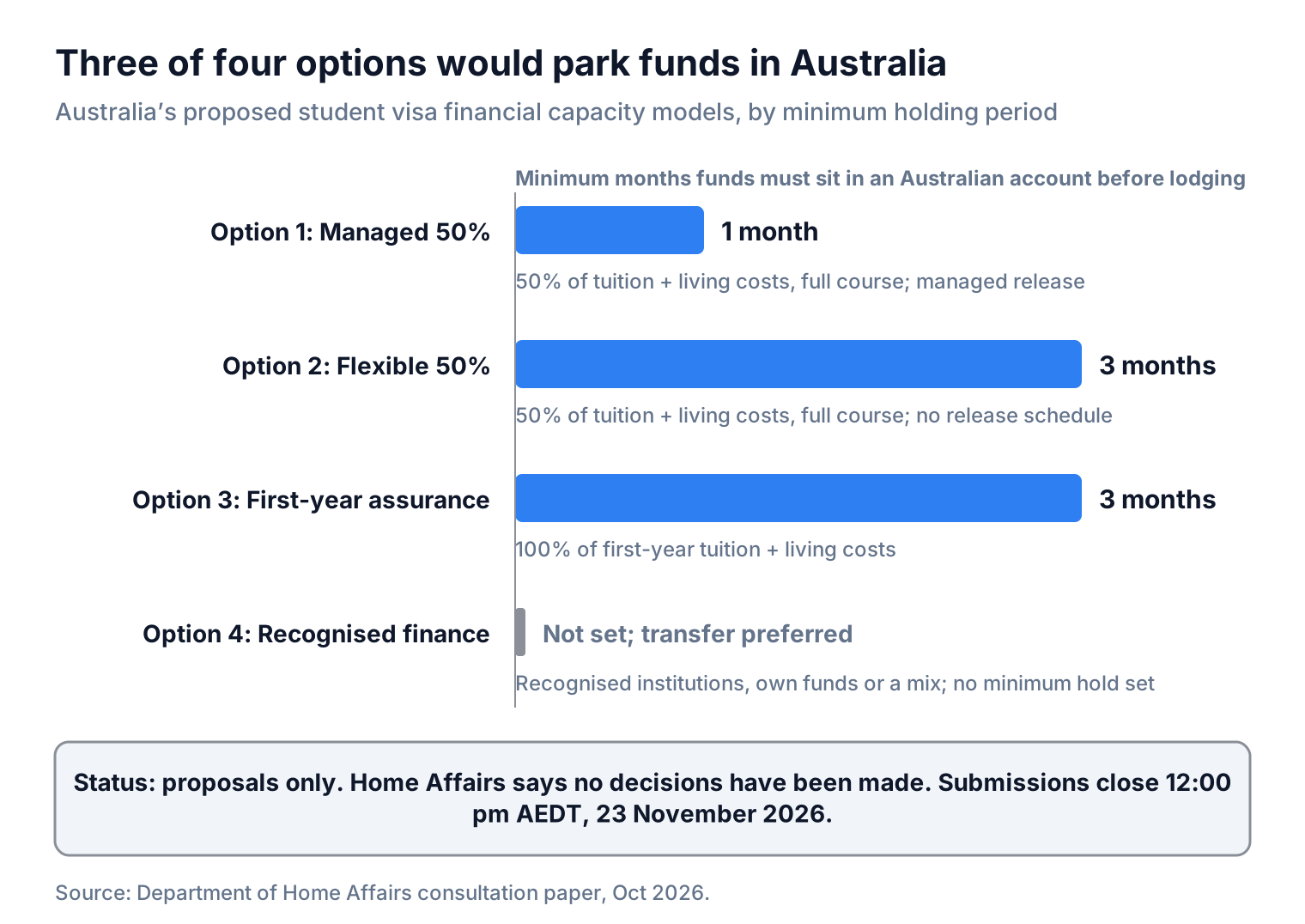
All four options would require proof of funds at lodgement, with verified overseas accounts allowed as a transition step. An interim proposal for applicants linked to Evidence Level 3 providers would require deposits backed by at least six months of transaction history, limit support to the applicant, spouse, parents or another prescribed supporter, and generally refuse unsecured personal loans and loans not yet disbursed. On the Genuine Student side, the paper suggests treating new students separately from continuing ones and no longer counting expected part-time earnings in Australia as proof of funds.
Education Post reports that the paper refers to the current annual living-cost figure of A$29,710, and that it should not be read as a proposed flat deposit. ICEF Monitor notes that refusals have reached unprecedented levels over the past year and that the AU$2,500 visa application fee is not refunded if a visa is refused. The Indian student agents’ body AAERI has called the first two options impractical.
What Indian students should do
- Applying for 2027 intakes? Today’s rules still apply. Keep funds in clearly documented accounts with a long, clean transaction history, since that is the direction of travel.
- Avoid last-minute deposits and unsecured personal loans. The interim proposal would treat them with suspicion.
- Want a say? Email student.visa.consultation@homeaffairs.gov.au before 12:00 pm AEDT on 23 November 2026. Individuals can respond, and you do not have to support the proposals.
- Watch for the final decision before you move large sums for a 2027 or 2028 intake.
Austria opens its Working Holiday visa to Indians
What changed: reports from 2 November 2026 confirm that Austria’s Working Holiday Programme is open to Indian citizens aged 18 to 30. It builds on the India–Austria Working Holiday agreement signed in Vienna in January 2023. Austria’s Foreign Minister Beate Meinl-Reisinger met External Affairs Minister S. Jaishankar in New Delhi on 28 October 2026, with mobility on the agenda. Austria already runs working holiday schemes with 11 partners, including Australia, Canada, Japan, South Korea and the United States.
How it works: the visa is a national Visa D for a stay of up to 12 months, with no extension. Holiday must be the main purpose of your trip, but you may take jobs to fund it without a separate work permit, and short courses are allowed as long as study stays secondary. No dependants can travel with you, and you can only use the programme in Austria once.
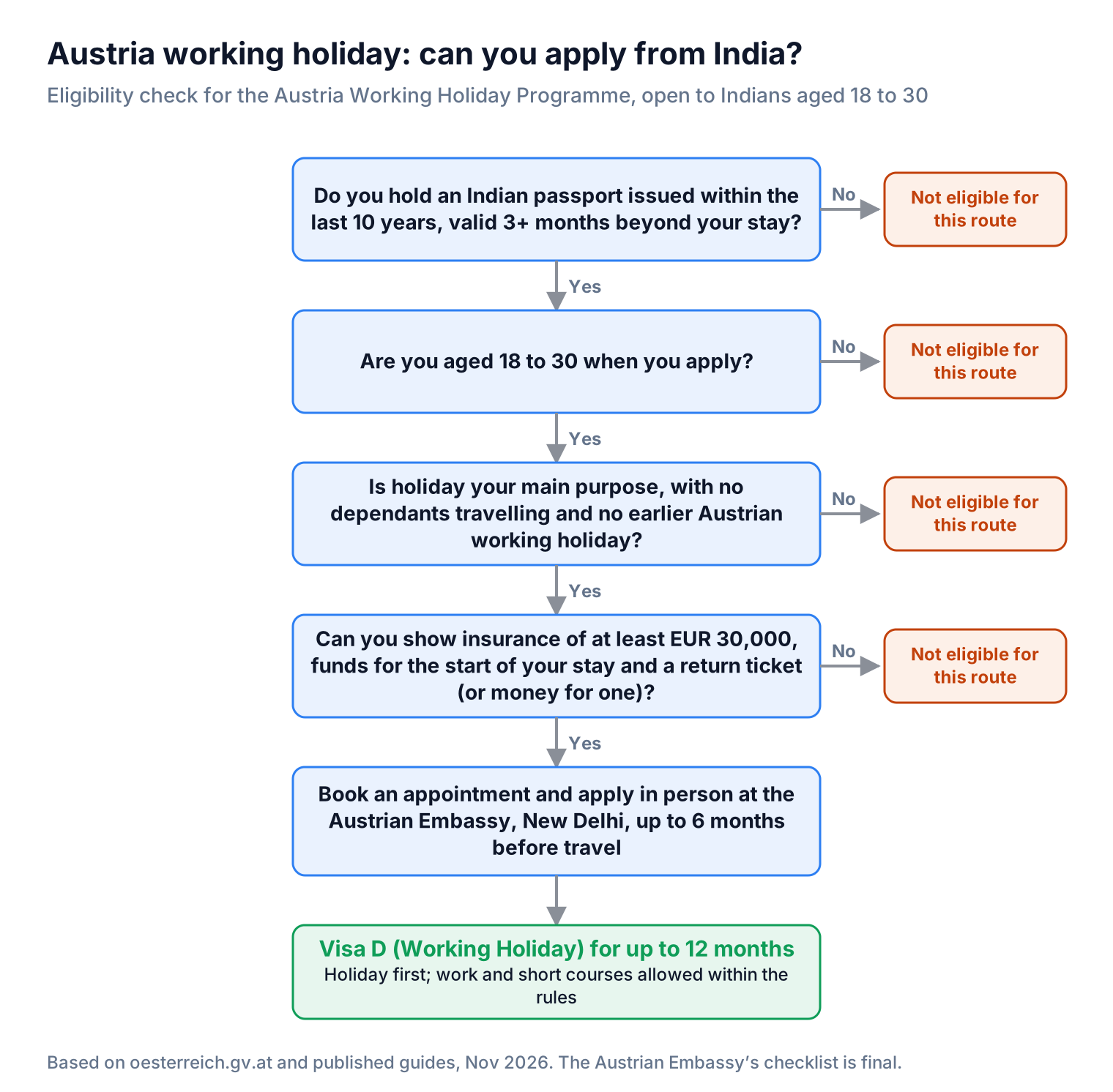
Documents and where to apply: apply in person, by appointment, at the Austrian Embassy in New Delhi, up to six months before your planned start date. Published guides list a signed Visa D form, a biometric photo, a passport issued in the last 10 years and valid at least three months beyond your stay, health and accident insurance of at least EUR 30,000, proof of funds for the start of your stay, and a return ticket or proof you can afford one. Guides differ on how long you may work in total, so check the embassy’s current checklist, fee and any annual quota before you book.
What Indian travellers should do
- Check your age on the application date. You must be 18 to 30 when you apply.
- Buy insurance first. EUR 30,000 cover for the full stay is a hard requirement.
- Plan travel within Schengen carefully. The Visa D is for Austria; confirm the travel rules for other Schengen countries before booking side trips.
- Do not use it as a job visa. If your main plan is full-time work or study, you need a different Austrian permit.
OCI late fee waived for passport updates until 31 December
What changed: Overseas Citizens of India (OCI) must update new passport details on the OCI portal within 90 days of the new passport being issued, or pay a late fee. Notices from Indian missions dated 3 November 2026, including the Consulate General in Vancouver and the High Commission in Canberra, announce a one-time waiver of that fee. It covers updates pending on 31 October 2026 and new updates filed between 1 November and 31 December 2026.
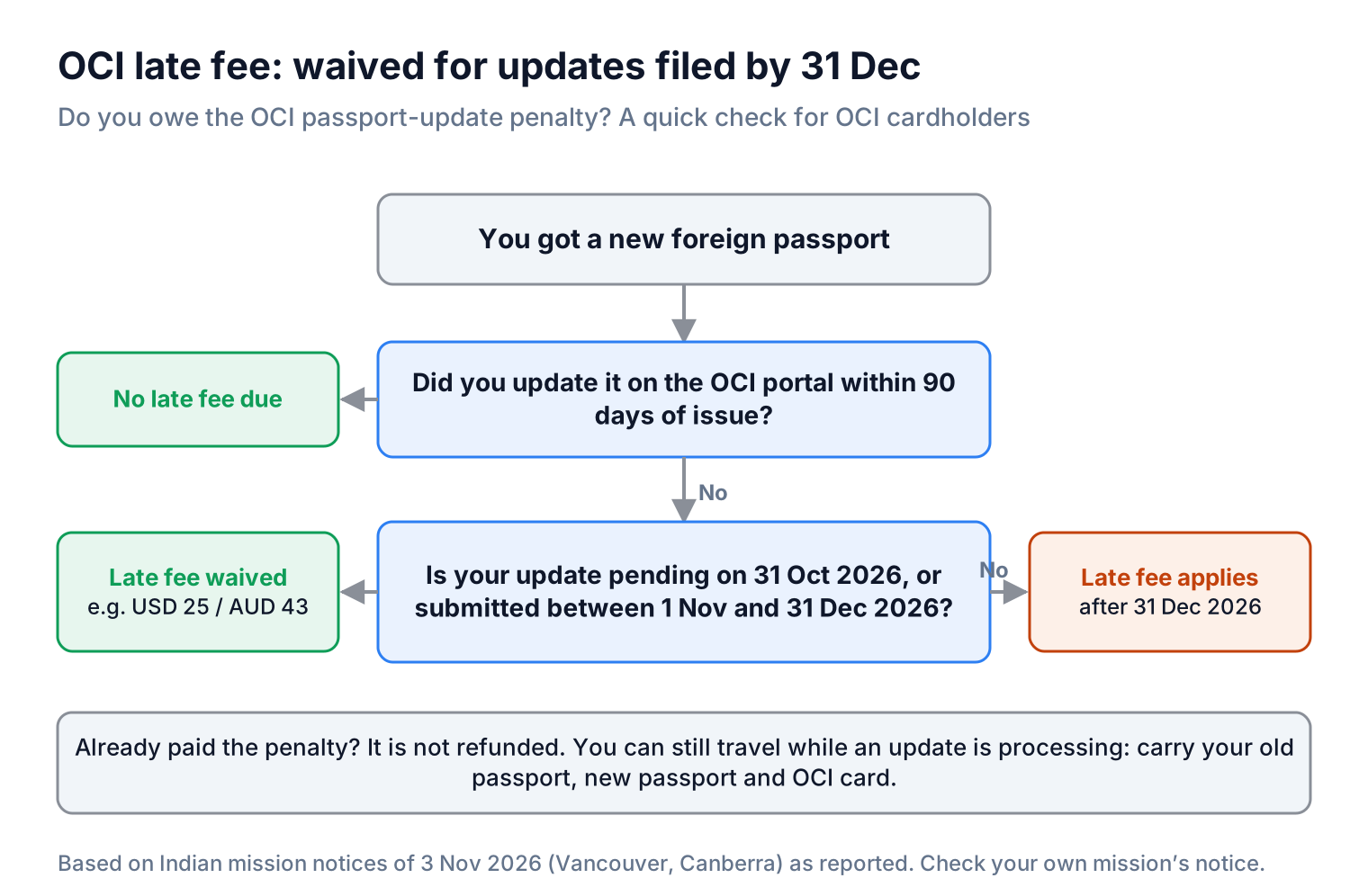
Local reports put the waived fee at USD 25 in Canada and AUD 43 in Australia. Penalties already paid will not be refunded, and the 90-day rule stays in place after the window closes. Changes to personal details such as name, nationality or a parent’s or spouse’s name need a separate application. You can travel while an update is processing if you carry your old passport, new passport and OCI card.
What to do: if anyone in your family has renewed a foreign passport and has not updated their OCI record, file the update before 31 December 2026 and keep the acknowledgement with your travel documents.
What to do now
- Australia students: keep studying under today’s rules, build a clean funds history, and send feedback by 23 November if you want a say.
- Austria hopefuls: check your age, arrange EUR 30,000 insurance and book an embassy appointment up to six months ahead.
- OCI families: file any overdue passport update before 31 December 2026.
- Confirm on official sites. Check Australia’s Department of Home Affairs, the Austrian Embassy in New Delhi and your Indian mission before you act.
Apply with Krosz
Planning a working holiday, a study trip or a Schengen visit? A trained Krosz visa expert handles your application one-to-one, checks your passport, forms and documents against current requirements, and flags problems before anything is filed. Decisions always rest with the destination country’s authorities.
The Krosz service fee is a flat ₹1,999 + 18% GST, with government fees shown separately at checkout.
Not sure which visa your plan needs? Check your visa requirements and start your application in minutes. Check your visa →
Sources
- Department of Home Affairs: Consultation on proposed reforms to the Genuine Student requirement and financial capacity framework
- Department of Home Affairs: Strengthening the Genuine Student requirement and financial capacity framework, consultation paper (PDF)
- ICEF Monitor: Australian government opens consultation on Genuine Student and financial requirements (5 Nov 2026)
- Education Post: Australia considers requiring international students to hold study funds in local bank accounts (4 Nov 2026)
- Times Higher Education: Mixed reaction to Australia’s financial capacity proposals (Nov 2026)
- NewsBytes: Austria launches working holiday visa for Indian citizens aged 18-30 (2 Nov 2026)
- Abroad Gateway: Austria Working Holiday visa for Indians (3 Nov 2026)
- oesterreich.gv.at: Working in the non-EU area (working holiday programmes)
- ThePrint: India, Austria sign agreements on migration and mobility, Working Holiday Programme (3 Jan 2023)
- DD India: Jaishankar meets Austrian Foreign Minister Beate Meinl-Reisinger in New Delhi (29 Oct 2026)
- Surrey News: India announces one-time waiver of $25 penalty for late OCI passport updates (4 Nov 2026)
- The Indian Sun: India waives $43 late fee for OCI passport updates until December 31 (5 Nov 2026)
*This article reflects information published up to 9 November 2026 and is general information, not legal or immigration advice. Always confirm requirements with the Department of Home Affairs, the Austrian Embassy in New Delhi or your Indian mission before you apply or travel.*
Frequently asked questions
Has Australia changed its student visa money rules?
Not yet. On 30 October 2026 the Department of Home Affairs opened a consultation on possible changes to the Genuine Student requirement and the financial capacity rules. It says no decisions have been made, and feedback will inform advice to the government on whether reforms go ahead. Submissions close at 12:00 pm AEDT on 23 November 2026.
Will Indian students have to keep money in an Australian bank account?
It is one of the proposals. Three of the four options in the consultation paper would require funds to be held in an eligible Australian account in the applicant’s own name for one or three months before lodging. A fourth option would accept recognised education finance, personal funds or a mix. Verified overseas accounts would be allowed during a transition period. None of this is in force today.
Can Indians apply for Austria’s Working Holiday visa?
Yes. Reports from early November 2026 confirm Austria’s Working Holiday Programme is open to Indian citizens aged 18 to 30. It is a national Visa D for a stay of up to 12 months, applied for in person at the Austrian Embassy in New Delhi. India and Austria signed a Working Holiday Programme agreement in January 2023.
Can I work in Austria on a working holiday visa?
Yes, within limits. The holiday must be the main purpose of the stay, but you may take jobs to fund your trip without a separate work permit. Published guides differ on how long you may work in total (some say up to six months), so confirm the current rule with the Austrian Embassy before you go. The visa cannot be extended and does not lead to permanent residence.
What documents do I need for the Austria working holiday visa?
Published guides list a signed Visa D application form, a biometric photo, an Indian passport issued in the last 10 years and valid at least three months beyond your stay, health and accident insurance of at least EUR 30,000 for the whole stay, proof of funds for the start of your stay, and a return ticket reservation or the means to buy one. The embassy may ask for more.
What is the OCI late-fee waiver?
OCI cardholders must update new passport details on the OCI portal within 90 days of the passport being issued, or pay a late fee. Indian mission notices dated 3 November 2026 waive that fee once for updates pending on 31 October 2026 and new updates filed between 1 November and 31 December 2026. The fee is USD 25 in Canada and AUD 43 in Australia, per local reports. Fees already paid are not refunded.
Can Krosz help with these visas?
Yes. A trained Krosz visa expert can check which visa fits your plan, review your documents and prepare your application one-to-one. The service fee is ₹1,999 + 18% GST, with government fees shown separately. Decisions always rest with the destination country’s authorities.
All visa destinations · Free visa tools · Pricing · Contact Krosz